
TL;DR:
- Advanced forex strategies rely on better tools, tight risk management, and fast execution.
- Infrastructure like low-latency VPS and careful risk controls are essential for multi-account trading success.
- Proper execution discipline and strategic diversification are more important than strategy complexity.
Standard strategies stop working the moment everyone uses them. If you’ve been grinding through basic breakouts or fixed-lot entries and hitting a ceiling, you’re not alone. The traders who break through that ceiling aren’t necessarily smarter. They use better tools, tighter risk frameworks, and faster execution. Advanced forex strategies include hedging, carry trades, statistical arbitrage, and algorithm-driven execution built for low-latency environments. This article walks through every layer: what hardware and software you need, which strategies actually hold up under pressure, how to replicate trades across multiple accounts, and how to manage risk without blowing prop firm rules.
Key Takeaways
| Point | Details |
|---|---|
| Prepare with the right tools | Reliable account setups, VPS, and trade copying software are essential for advanced forex trading. |
| Use evidence-based strategies | Hedging, carry trades, and quant models are associated with more structured risk management compared to basic directional approaches, though outcomes depend on implementation and market conditions. |
| Replicate and scale safely | Master-follower architectures and phased allocation help replicate trades across accounts while minimizing correlated risk. |
| Prioritize low-latency execution | Placing servers closer to brokers can dramatically reduce slippage and boost your trading outcomes. |
| Risk management is non-negotiable | Setting strict risk limits and monitoring portfolio correlation are critical for prop firm and multi-account survival. |
Prepare for advanced trading: Tools and requirements
Before running any advanced strategy, your infrastructure has to match your ambition. A slow VPS, mismatched platforms, or an unverified copier setup will cost you more than a bad trade will.
The three main trader profiles each need slightly different setups. Retail traders managing personal accounts need a stable Windows VPS, MetaTrader 4 or MT5, and a local trade copier. Independent account managers need a master account terminal plus client account terminals, all on the same machine. Prop firm traders need on-machine execution to keep all activity on one IP, avoiding cloud routing flags.
| Trader type | Platform needed | Key tool | VPS location |
|---|---|---|---|
| Retail multi-account | MT4 or MT5 | Local trade copier | Broker datacenter |
| Account manager | MT4/MT5 master + clients | Copier with lot scaling | NY or London |
| Prop firm trader | MT4/MT5 or DXTrade | On-machine EA copier | Prop firm’s datacenter |
Trade copying across multiple accounts requires a master-follower architecture using VPS and fast local copiers. That architecture is the backbone of every advanced multi-account setup. For deeper context on building this out, the automated trading workflow guide covers the full process.
Latency matters more than most traders realize. A VPS located in the same datacenter as your broker can cut execution delay dramatically. Low-latency execution depends on physical proximity between your server and the broker’s matching engine.
Pre-deployment checklist:
- Confirm copier compatibility with your MT4, MT5, or DXTrade version
- Test round-trip latency from VPS to broker server
- Validate lot sizing logic on a demo account before going live
- Set drawdown limits before the first live trade
- Confirm prop firm rules on trade copying and EA usage
Pro Tip: Run your copier on a demo master and live client for 48 hours before full deployment. This catches lot scaling mismatches and latency spikes before they cost real money.
For a solid grounding in the multi-account management basics, review the core concepts before scaling up.
Core advanced strategies: Hedging, carry trades, and quant models
Once your environment is ready, the strategies you apply determine your edge. Three approaches are widely used at the professional level as alternatives to basic directional trading.
Trader reviewing hedging forex trades
Hedging means opening offsetting positions to reduce net exposure. In a copier context, this could mean running a long EUR/USD on one account while hedging with a short EUR/GBP on another, using correlated pairs to cap downside without closing the original trade.
Carry trades exploit interest rate differentials between currencies. You go long on a high-yield currency and short on a low-yield one, collecting the overnight swap. Dynamic sizing adjusts your position as rate differentials shift. Academic research on carry trade strategies presents mixed findings. Some studies identify conditional improvements through active position sizing, while others find that carry trade profitability is not persistent out of sample. Traders should consult primary research rather than assuming a consistent structural edge.
Machine learning models like LSTM (Long Short-Term Memory) networks identify non-linear patterns that rule-based systems miss. Research into LSTM-based forex models has shown improved Sharpe ratios compared to static rule-based approaches in controlled backtest settings, though live results vary significantly by model design, market regime, and implementation quality.
Past performance figures cited in academic or backtest research do not guarantee future results. All trading strategies involve risk of loss, and individual outcomes will vary based on execution, market conditions, broker behavior, and account-specific factors.
| Strategy | Strength | Weakness |
|---|---|---|
| Hedging | Caps downside, protects open trades | Reduces upside; complex to manage |
| Carry trade | Consistent income from rate differential | Vulnerable to sudden rate reversals |
| ML/statistical model | Adapts to non-linear market behavior | Requires data infrastructure and tuning |
Implementing a carry trade with hedging:
- Identify a currency pair with a strong positive swap rate
- Size the position using dynamic lot calculation based on current account equity
- Open a partial hedge on a correlated pair to limit drawdown exposure
- Set a hard stop loss; never widen it after entry
- Monitor rate differential weekly and resize if the differential narrows
You can configure custom risk settings per symbol in Local Trade Copier, which makes dynamic sizing across multiple accounts far more manageable.
Pro Tip: Walk-forward optimization tests your strategy on unseen data after initial backtesting. It’s the most reliable way to avoid curve-fitting, where a model looks great on historical data but fails live.
Master multi-account trading: Trade replication, scaling, and risk
Selecting the right strategies is only half the job. Coordinating execution across accounts without creating correlated risk is where most traders lose control.
Setting up multi-account replication:
- Install your trade copier on a Windows VPS or local machine
- Assign one terminal as the master and all others as clients
- Configure per-account lot sizing using balance-proportional scaling
- Set individual drawdown caps for each client account
- Test with micro-lots before scaling to full position sizes
Master-follower replication uses VPS for low-latency copying, with risk per trade set at 0.25-0.5% to avoid correlation breaches across accounts.
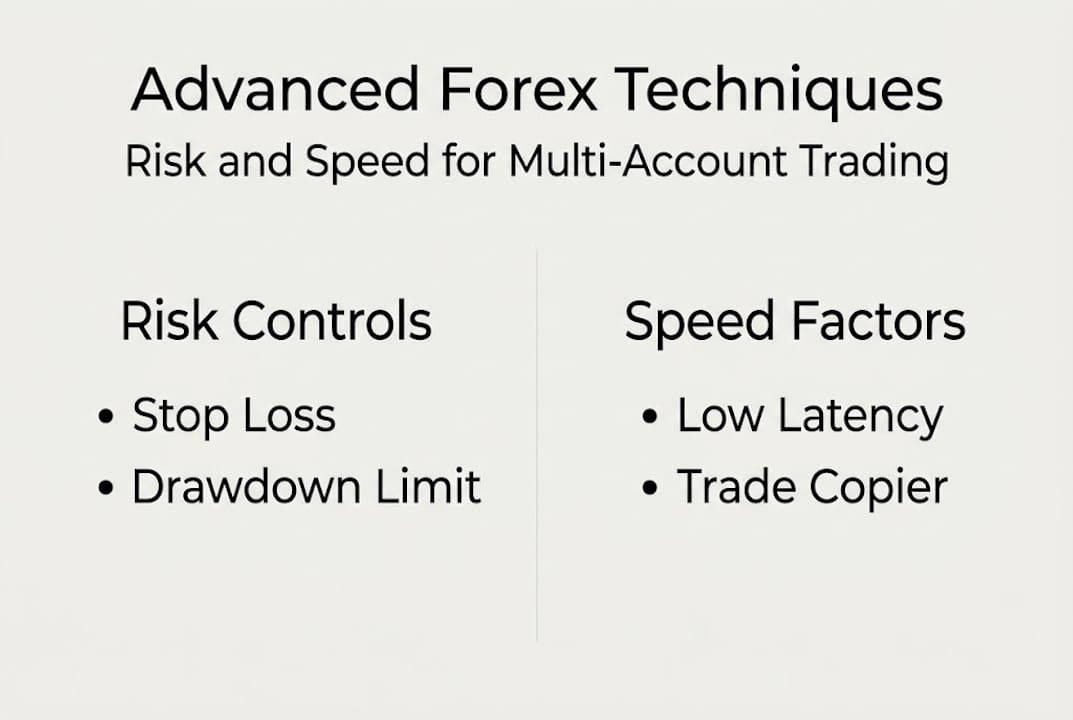
Infographic on forex risk and speed techniques
| Infrastructure | Typical latency | Best for |
|---|---|---|
| Local machine (same broker) | Under 100ms | Single broker, low volume |
| VPS in broker datacenter | 10-50ms | Multi-account prop traders |
| Co-located server | Under 10ms | High-frequency strategies |
Risk controls to enforce per account:
- Maximum open risk across all accounts: 2% of total capital
- Per-trade risk: 0.25-0.5% per account
- Daily drawdown cap: 4-5% before halting new entries
- Correlation check: avoid running the same directional bias on more than two accounts simultaneously
Prop firms have strict rules on drawdown. Review copy trading prop firms guidelines before deploying replication across funded accounts. Phased scaling, where you start with one account and add others only after confirmed profitability, prevents a single strategy failure from wiping multiple accounts at once. For a full walkthrough, the trade copying best practices guide and multi-account setup instructions are the right starting points. You can also see a practical MT4 master-to-clients setup example for a three-account configuration.
Low-latency execution: Speed, slippage, and infrastructure
Replicating trades isn’t enough if execution is slow. Speed determines fill quality, and fill quality determines whether your backtested edge survives in live markets.
Server location is the single biggest variable. A VPS in a New York or London datacenter, co-located near your broker’s matching engine, cuts the round-trip time from hundreds of milliseconds to under 50ms. VPS in broker datacenters, co-location, and FPGAs enable low-latency execution, with network delays often under 200ms and HFT solutions operating at the microsecond level.
Hardware needed for sub-200ms execution:
- Windows VPS with at least 2 CPU cores and 4GB RAM
- SSD storage for fast platform loading and EA execution
- Dedicated IP address (no shared hosting)
- Fiber or datacenter-grade network connection
- Broker proximity: same city or datacenter as the broker’s server
| Setup | Latency range | Cost level | Best for |
|---|---|---|---|
| Retail home PC | 100-500ms | Low | Casual multi-account traders |
| VPS (broker datacenter) | 10-100ms | Medium | Prop firm and advanced retail |
| Co-located server | Under 10ms | High | Institutional or semi-HFT |
Warning: Over-optimizing for latency without monitoring slippage is a trap. A 5ms improvement in execution speed means nothing if your platform is filling at 3-pip slippage on volatile pairs. Always track average fill deviation, not just raw speed.
For retail traders, a VPS-optimized algo offers the best balance of cost, risk, and latency. Institutional HFT hardware is overkill unless you’re running strategies that depend on microsecond execution windows. Cross-broker replication tips and a review of fast copier solutions will help you match infrastructure to your actual strategy needs. For further context on VPS for low latency, broker-adjacent VPS setups consistently outperform home connections for execution speed and reliability.
Risk management for sustained success
Infrastructure gets you in the door. Risk management keeps you in the game.
Building a fractional risk framework:
- Set per-trade risk at 0.25-0.5% of account equity
- Cap total open risk across all positions at 2%
- Define a daily drawdown limit of 5% before stopping new entries
- Monitor portfolio correlation weekly; flag any two positions with correlation above 0.7
- Automate drawdown halts using copier logic or EA conditions
The 2% maximum risk per trade is a widely cited guideline in trading risk management literature. Daily drawdown limits of 5-10% and active portfolio correlation monitoring are common practices among multi-account traders, though specific thresholds vary by trader profile and prop firm requirements.
Prop firm compliance adds another layer. Most firms enforce a 5% daily drawdown and a 10% total drawdown limit. Breaching either ends the account. Automated stops built into your copier or EA remove the temptation to override those limits during a losing streak.
For carry trades specifically, the carry trade risk guide outlines how to adjust position sizing as rate differentials shift, which is essential for keeping carry exposure within drawdown limits.
Pro Tip: Never expand a stop loss after entry, even after a drawdown. It’s the single most common way traders turn a manageable loss into an account-ending one. Automate this rule through your copier’s trade management logic so the temptation is removed entirely.
The forex account management benefits page covers how systematic account management frameworks reduce emotional override risk across multiple accounts.
Perspective: What most miss about advanced forex trading
Here’s what years of working with traders across prop firms and multi-account setups actually reveals: most traders chase strategy complexity when the real edge comes from execution discipline.
Popular strategies like London Breakout underperform because algorithms arbitrage them the moment they become widely known. Carry and value factors consistently outperform naive approaches, not because they’re complicated, but because they’re grounded in structural market forces rather than pattern recognition.
The traders who scale successfully aren’t running exotic models. They’re running solid strategies with airtight replication, strict drawdown rules, and fast local execution. They don’t stack correlated trades across accounts thinking diversification is automatic.
Stacking the same directional bias across five prop accounts isn’t diversification. It’s concentrated risk wearing a diversification costume.
For retail traders, the real competitive advantage isn’t matching institutional HFT infrastructure. It’s combining smart strategy selection with fast, on-machine execution and consistent risk controls. Diversifying across prop firms and strategies, as outlined in prop firm best practices, protects your income even when one account hits its drawdown limit.
Upgrade your advanced trading workflow
Every technique in this article depends on one thing: reliable, fast trade replication with configurable risk controls per account. That’s exactly what Local Trade Copier delivers.
](https://mt4copier.com)](https://mt4copier.com)](https://mt4copier.com)](https://csuxjmfbwmkxiegfpljm.supabase.co/storage/v1/object/public/blog-images/organization-20479/1773294400737_mt4copier.jpg)
Running entirely on your local Windows machine or VPS, Local Trade Copier replicates trades across MT4, MT5, and DXTrade accounts in 1 second or faster under normal market conditions, with no cloud routing and no external IP exposure. It includes eight money management modes, automatic balance-proportional scaling, and full cross-platform support under one subscription. Start with the Local Trade Copier installation guide, explore the fast trade copier execution features, and review trade copier execution safety settings to configure stop loss and take profit handling correctly from day one. A 7-day free trial is included.
Frequently asked questions
What is the best advanced forex strategy for multi-account traders?
Carry trades with dynamic hedging or machine learning-based models provide robust returns for multi-account setups when combined with rigorous replication and risk controls. Carry strategies with active hedging have demonstrated improved risk-adjusted metrics in research settings compared to passive carry positions. Results vary by market regime and implementation.
How much risk per trade is safe for prop firm forex accounts?
Most experts recommend risking just 0.25-0.5% per trade and never exceeding 2% total open risk to avoid breaching prop firm limits. Daily drawdown limits typically sit at 5-10% for prop firm compliance.
Why does latency matter for advanced forex trading?
Low-latency execution reduces slippage and improves fill quality, especially for high-frequency strategies or prop firm rules that require real-market timing. Network delays under 200ms are achievable with a broker-adjacent VPS, while HFT solutions operate at the microsecond level.
Can trade copiers be used without violating prop firm rules?
Yes, if you avoid latency exploits and diversify among firms and strategies, most prop firms allow trade copying when executed through real orders. Prop firms permit copying but enforce real-market rules, so on-machine execution with a local copier is the safest approach.
Recommended
- Master forex trading terms for efficient account management
- Copy Forex Trades with Different Risk Settings for Each Pair
- Scalping and Copy Trading on MT4 and MT5 (Best Setup to Avoid Delay and Slippage)
- Most Effective Strategies for Managing Risk in Forex Trading | Trade Copier for MT4 & MT5
