

Managing multiple forex accounts effectively requires mastery of trade copying best practices. Whether you’re a prop trader juggling funded accounts or an account manager scaling client portfolios, trade copying can streamline your operations and amplify returns. However, without proper setup, you risk slippage, duplicate trades, and correlated losses that erode profitability. This article unveils proven frameworks and expert tips to optimize your trade copying setup, covering risk management, latency reduction, symbol mapping, and performance monitoring. You’ll learn how to select the right methods, avoid common pitfalls, and implement data-backed strategies that enhance both security and cost-effectiveness across your trading ecosystem.
Key Takeaways
| Point | Details |
|---|---|
| Risk management setup | Configure stop loss and take profit overrides on follower accounts, apply lot or equity proportional sizing, and set daily or weekly loss caps to limit drawdowns. |
| Latency and mapping | Deploy the copier on a VPS or cloud near your broker to achieve sub 100 ms execution and implement bidirectional symbol mapping to handle discrepancies like EURUSD versus EUR/USD. |
| Diversify masters and monitor | Diversify by copying multiple uncorrelated masters and monitor performance regularly to detect red flags and avoid correlated drawdowns. |
| Security and regulation | Choose regulated platforms with encrypted transmission to enhance security and reduce fraud risk while avoiding unverified cloud services. |
| Demo testing and KPIs | Test the setup in a demo environment for at least two weeks to uncover configuration errors and latency issues before risking live capital. |
1. Evaluating trade copying criteria for forex efficiency
Before launching any trade copying setup, you need to establish clear criteria that align with your risk tolerance and operational goals. Best practices include adjusting risk settings, monitoring, diversifying masters, using VPS/cloud, and ensuring broker compatibility and security. These foundational elements determine whether your multi-account strategy thrives or collapses under pressure.
Start with risk parameters. Configure stop loss and take profit overrides on follower accounts to cap potential losses. Use lot multipliers or equity-proportional sizing to scale trades appropriately for each account’s balance. Implement daily or weekly loss caps to prevent catastrophic drawdowns during volatile market conditions. These controls act as circuit breakers, protecting your capital when master traders experience unexpected losses.
Latency optimization is equally critical. Deploy your trade copier on a VPS or cloud server located near your broker’s data center to achieve sub-100ms execution times. This minimizes slippage and ensures follower accounts receive pricing close to the master account’s entry and exit points. Even a 50ms delay can cost you several pips per trade, compounding into significant losses over hundreds of transactions.
Broker and platform compatibility requires thorough verification. Check that symbol names match across brokers or configure bidirectional symbol mapping to handle discrepancies like EURUSD versus EUR/USD. Confirm that your brokers support the same order types, such as market orders, pending orders, and trailing stops. Mismatched capabilities can cause trades to fail silently or execute incorrectly.
Security considerations include using regulated platforms with encrypted data transmission and avoiding unverified third-party cloud services that expose your trading data. Review your forex trade copying guide to understand how local versus cloud solutions impact data privacy. Regulated brokers and transparent copier providers reduce the risk of fraud or technical failures.
Diversify by copying multiple uncorrelated master accounts. If all your masters trade the same currency pairs with similar strategies, a single market event can trigger correlated drawdowns across your entire portfolio. Instead, select masters with different trading styles, timeframes, and asset classes to spread risk effectively. Understanding copy trader metrics and red flags helps you identify high-quality sources.
Pro Tip: Test your trade copying setup in a demo environment for at least two weeks before deploying live capital. This reveals configuration errors, symbol mismatches, and latency issues without financial consequences.
2. Comparing trade copying methods and technologies
Trade copying methods vary widely in complexity, cost, and performance. Understanding the strengths and limitations of each approach helps you select the right technology for your specific needs.
Local Expert Advisors for MT4 and MT5 offer low cost and customizable risk settings. You install the EA on both master and follower accounts, and it copies trades via file sharing or direct terminal communication. This method provides full control over execution logic and eliminates recurring cloud subscription fees. However, it requires stable server uptime and manual updates when brokers change symbol specifications.
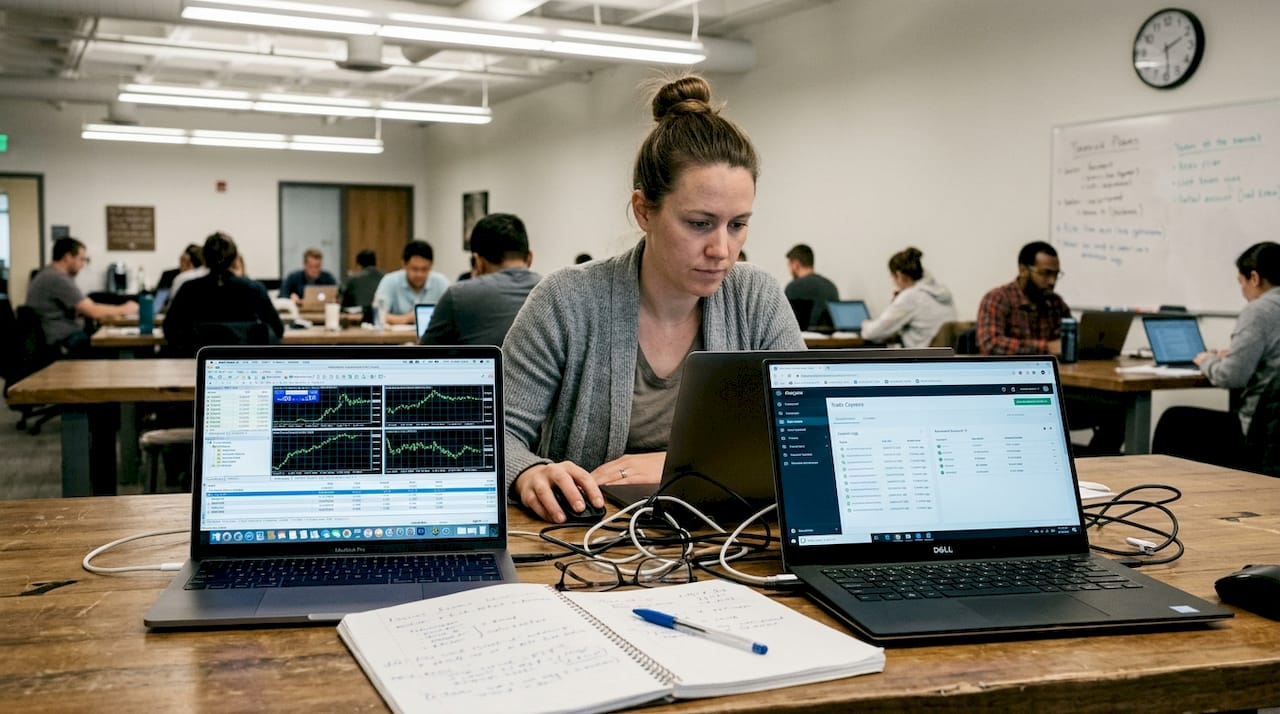
Woman comparing forex trading platforms
Cloud-based copiers reduce latency issues by hosting the copying logic on remote servers near broker data centers. They enable remote management from any device and often include advanced features like performance analytics and automated risk adjustments. The tradeoff is higher monthly fees and reliance on third-party infrastructure. If the cloud provider experiences downtime, your copying stops until service resumes.
API and file sharing methods allow flexible integration across different platforms and brokers. You can build custom workflows that trigger trades based on external signals or combine multiple data sources. These methods require robust error handling to prevent duplicate trades and must manage symbol and order type mismatches programmatically. Trade copying mechanics may involve fixed lot, lot multiplier, equity-proportional sizing, and risk-percent sizing to adjust for account differences.
Sizing formulas are essential for aligning trade sizes across accounts with different balances. Fixed lot sizing copies the exact lot size from master to follower, which works only when accounts have similar equity. Lot multipliers scale trades by a constant factor, offering simplicity but lacking dynamic adjustment. Equity-proportional sizing calculates follower lot size based on the ratio of follower equity to master equity, maintaining consistent risk exposure. Risk-percent sizing allocates a fixed percentage of account equity per trade, adapting automatically as balances fluctuate. Review forex copier mechanisms to see how different formulas impact performance.
Symbol and order type mismatches require careful handling. If your master trades XAUUSD but your follower’s broker lists it as GOLD, the copier must translate symbols in real time. Some brokers restrict pending orders or don’t support trailing stops, forcing you to convert order types or skip certain trades. Understanding multi-account trade copying nuances prevents execution failures.
| Method | Cost | Latency | Customization | Complexity |
|---|---|---|---|---|
| Local EA | Low | Medium | High | Medium |
| Cloud Copier | High | Low | Medium | Low |
| API Integration | Variable | Low | Very High | High |
| File Sharing | Low | High | Medium | Medium |
Pro Tip: Start with a cloud copier if you prioritize ease of use and low latency, then transition to a local EA once you’ve mastered the fundamentals and want to reduce ongoing costs.
3. Managing advanced challenges in trade copying setups
Even well-configured trade copiers encounter technical challenges that can disrupt performance and erode profitability. Mastering these nuances separates amateur setups from professional-grade systems.
Duplicate trades occur when network delays or broker communication errors cause the copier to send the same order multiple times. Implement cooldown periods of at least three minutes between identical trade signals to prevent this issue. Some copiers track order IDs or magic numbers to detect and skip duplicates automatically. Without these safeguards, you might open two positions when you intended only one, doubling your risk exposure.
Symbol mapping requires bidirectional translation between broker naming conventions. Configure your copier to recognize that EURUSD on one broker equals EUR/USD on another, and vice versa. This mapping must handle suffixes like .pro or .raw that some brokers append to symbol names. Incorrect mapping causes trades to fail silently or execute on the wrong instrument.
Slippage management starts with low latency servers. Expert nuances include using cooldowns to avoid duplicates, VPS/cloud for latency under 100ms, symbol bidirectional mapping, and filters for max positions and spreads. Place your copier on a VPS located near your broker’s data center to minimize network hops. For trades with multiple take profit levels, split orders carefully to avoid partial fills that leave orphaned positions.
Filters respect broker and prop firm rules by limiting maximum positions and avoiding excessive spreads. Set filters to skip trades when the spread exceeds a threshold like 3 pips for major pairs or 10 pips for exotics. This prevents entering trades during low liquidity periods when slippage is highest. Configure maximum position limits to comply with prop firm rules that restrict the number of simultaneous trades.
Auto-close logic maintains alignment between master and follower accounts. When the master closes a trade, the copier should immediately close the corresponding follower positions. Delays in auto-close can leave follower accounts exposed to adverse price movements after the master has exited. Some copiers offer partial close synchronization, copying the exact percentage of position reduction from master to follower. Explore trade copier safety improvements to understand how these features protect your accounts.
- Enable cooldown periods of 3 to 5 minutes to block duplicate trade signals.
- Configure bidirectional symbol mapping to handle broker naming variations.
- Deploy copiers on VPS with sub-100ms latency to reduce slippage.
- Set spread and position filters to comply with broker and prop firm rules.
- Activate auto-close logic to synchronize exits between master and follower accounts.
| Challenge | Solution | Impact |
|---|---|---|
| Duplicate Trades | Cooldown periods | Prevents double exposure |
| Symbol Mismatch | Bidirectional mapping | Ensures correct execution |
| Slippage | Low latency VPS | Improves price matching |
| Excessive Spread | Spread filters | Avoids high-cost entries |
| Orphaned Positions | Auto-close logic | Maintains alignment |
4. Proven best practices to optimize profitability and risk
Data-backed strategies and continuous monitoring transform trade copying from a passive replication tool into an active risk management system that enhances profitability.
Select master traders with less than 20% maximum drawdown and at least six months of consistent performance. High returns are attractive, but sustainability matters more.
Important: All trading involves the risk of loss. The thresholds and guidelines below represent general heuristics discussed by practitioners — they do not guarantee profitable outcomes. Past performance of any master trader is not indicative of future results. Research on copy trading outcomes consistently shows that fewer than half of followers are profitable over any given 90-day period — success hinges on choosing low-drawdown, consistent masters rather than chasing high returns. Review monthly returns, Sharpe ratios, and win rates to identify masters with robust risk-adjusted performance. Note: Historical drawdown and performance figures reflect past results only. Past performance is not indicative of future results.
Regularly monitor performance metrics and adjust risk allocation based on evolving market conditions. Track metrics like average trade duration, profit factor, and maximum consecutive losses for each master. If a previously reliable master experiences a drawdown exceeding 15%, reduce your allocation or pause copying until performance stabilizes. Most professionals allocate 20 to 50% of their capital per master trader to limit concentrated risk.
Demo test copy setups before live deployment to iron out configuration issues cost-effectively. Run your copier in a demo environment for at least two weeks, simulating real market conditions with multiple masters and varying lot sizes. This reveals symbol mapping errors, latency problems, and filter misconfigurations without risking actual capital. Demo testing also familiarizes you with the copier’s interface and alert systems.
Diversify by copying multiple uncorrelated masters to limit correlated losses. If you copy three masters who all trade EUR/USD with similar strategies, a single ECB announcement can trigger simultaneous losses across your portfolio. Instead, combine a scalper, a swing trader, and a news trader who operate on different timeframes and currency pairs. This diversification smooths your equity curve and reduces volatility.
Use equity stops and broker-approved regulated platforms to enhance security and regulatory compliance. Equity stops automatically close all positions when your account balance falls below a predetermined threshold, preventing total account wipeout. Choose brokers regulated by authorities like the CFTC, FCA, or ASIC to ensure fair execution and dispute resolution. Consult IOSCO copy trading guidelines for international regulatory standards.
- Select masters with <20% drawdown and >6 months consistency for stable returns.
- Monitor performance metrics monthly and adjust allocations based on current data.
- Demo test all configurations for at least two weeks before deploying live capital.
- Diversify across uncorrelated masters to reduce portfolio volatility and correlated risk.
- Implement equity stops and use regulated brokers to protect capital and ensure compliance.
Disciplined risk management, continuous monitoring, and diversification across uncorrelated strategies are the factors that separate sustainable copy trading setups from those that fail — chasing high returns without evaluating drawdown and consistency is one of the most common causes of significant losses.
Explore benefits of forex account management to understand how professional-grade tools support these best practices and scale your operations efficiently.
How the Local Trade Copier simplifies multi-account management
Implementing best practices becomes straightforward when you use tools designed with these principles in mind. The Local Trade Copier supports advanced risk settings like lot multipliers and equity-proportional sizing, allowing you to tailor each follower account’s exposure precisely. Installation guides and demo videos ease new user onboarding, reducing the learning curve for traders unfamiliar with trade copying technology. Note: Local Trade Copier runs on Windows PC or Windows VPS. Mac OS is not natively supported; a Wine simulator or remote Windows VPS is required for Mac users.
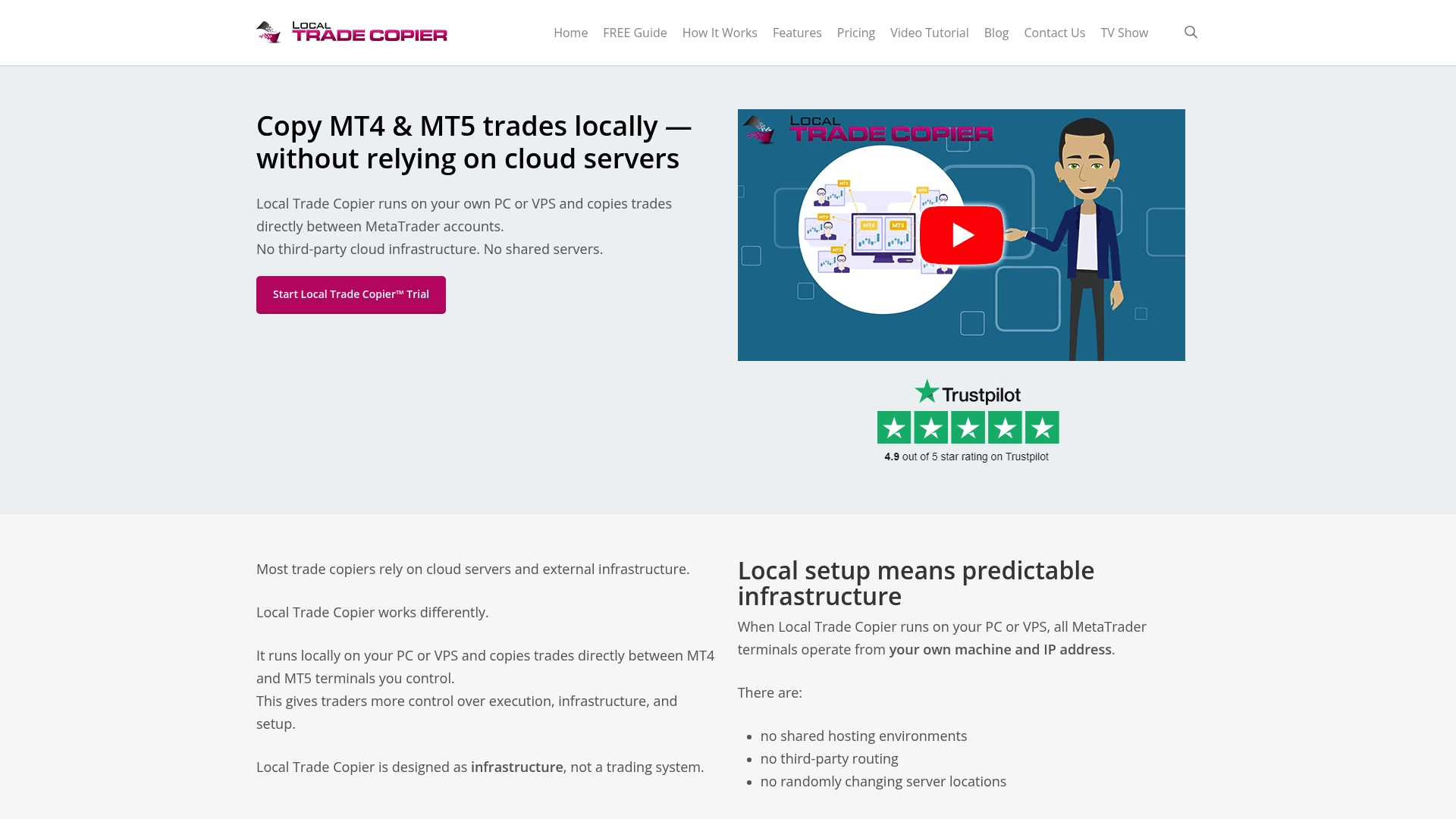
Safety improvements address prop firm and retail trader concerns with filters and auto-close features that respect position limits and synchronize exits. You can configure spread filters, cooldown periods, and symbol mapping directly within the interface, eliminating the need for custom scripting. Account scaling is license-tier dependent — the Personal plan supports one PC/VPS instance, the Manager plan supports five, and the VIP plan supports fifteen simultaneous instances. Review the trade copier installation process to see how quickly you can deploy a professional-grade setup. Explore trade copier SL and TP features to understand how the software manages stop loss and take profit synchronization. For comprehensive protection, consult trade copier safety improvements to see how the platform adapts to evolving market and regulatory requirements.
Pro Tip: Utilize demo versions for risk-free evaluation before live deployment. This lets you test all features and confirm compatibility with your brokers without financial exposure.
FAQ
What is the best lot sizing method for trade copying?
Equity-proportional sizing is often preferred because it adapts to follower account equity automatically, maintaining consistent risk exposure as balances fluctuate. Common lot sizing methods include fixed lots, lot multipliers, equity-proportional sizing, and risk-percentage sizing to align with follower equity. Fixed lot sizing is simpler but less tailored, working only when master and follower accounts have similar balances. Risk-percentage sizing allocates a fixed percentage of equity per trade, offering dynamic adjustment but requiring more complex calculations.
How can I minimize slippage when copying trades?
Deploy your copy software on a low-latency VPS located near your broker’s data center to achieve execution times under 100 milliseconds. Using VPS or cloud copiers with execution latency under 100 milliseconds reduces slippage significantly by ensuring follower accounts receive pricing close to the master’s entry and exit points. Select cloud copiers with sub-100ms execution times for better price matching, especially during high-volatility periods when spreads widen rapidly.
What risk measures should I use when managing multiple copy trades?
Set daily loss limits to cap potential drawdowns at 2 to 5% of account equity, preventing catastrophic losses during volatile market conditions. Recommended risk settings include daily/weekly loss limits around 2-5%, allocating 20-50% risk per trader, and regular reviews every 30 days. Distribute risk among multiple master traders for diversification, ensuring no single master controls more than 50% of your capital. Review performance metrics monthly and adjust allocations based on current drawdown and consistency data.
How do I handle symbol mismatches between brokers?
Configure bidirectional symbol mapping in your trade copier to translate symbol names automatically between brokers. For example, map EURUSD on one broker to EUR/USD on another, handling suffixes like .pro or .raw that some brokers append. Test mappings in a demo environment to confirm trades execute on the correct instruments before deploying live capital.
Should I copy trades manually or use automated software?
Automated software offers speed, consistency, and scalability that manual copying cannot match, especially when managing multiple follower accounts. Manual copying introduces human error, delays, and fatigue, increasing the risk of missed trades or incorrect lot sizes. Automated copiers execute trades in milliseconds, apply risk filters consistently, and operate 24/7 without supervision, making them the preferred choice for professional account managers and prop traders.
Recommended
- The Definitive Guide to Forex Trade Copying
- Scalping and Copy Trading on MT4 and MT5 (Best Setup to Avoid Delay and Slippage)
- Benefits of Forex Account Management | Local Trade Copier
- How Forex Copy Traders Create Portfolio of Best Strategies
