

Misunderstanding a single forex term can cost you real money. Traders who confuse lot sizes, misread leverage ratios, or ignore drawdown limits have blown accounts that were otherwise profitable. If you manage multiple accounts or copy trades across platforms, the stakes are even higher because one misconfigured setting replicates across every account simultaneously. This guide cuts through the confusion and gives you clear, practical definitions of the terms that matter most, along with how they apply directly to multi-account and copy trading workflows.
Key Takeaways
| Point | Details |
|---|---|
| Know your trading terms | Understanding pip, lot, margin, and leverage prevents errors and helps you manage risk smarter. |
| Automate for efficiency | Using PAMM, MAM, and copy trading solutions can streamline multi-account management and reduce manual workload. |
| Protect your capital | Proper use of stop loss, take profit, and drawdown monitoring keeps losses in check and profits secured. |
| Control execution risks | Anticipate slippage and requote issues, and deploy strategies to minimize their impact during volatility. |
| Measure performance wisely | Don’t rely solely on backtests; use metrics like Sharpe ratio and drawdown to track live account success. |
Disclaimer: This content is for informational and educational purposes only. Local Trade Copier is a trade replication tool, not a financial advisor or signal service. Trading involves significant risk of loss. The risk management guidelines and performance metrics discussed in this article are reference frameworks only — they do not guarantee results. Consult a licensed financial advisor before making investment decisions.
Understanding core forex trading terms
Every forex trader uses these terms daily, but surprisingly few can define them precisely under pressure. That gap between casual familiarity and real understanding is where costly mistakes live.
A pip is the smallest price move in a currency pair, typically 0.0001 for most pairs. On EUR/USD, moving from 1.1050 to 1.1051 is one pip. When you scale that across a standard lot, one pip equals $10. Multiply that by 20 open trades across five accounts and you see why pip precision matters.
Lot sizes define how much currency you actually trade. A standard lot equals 100,000 units of the base currency, a mini lot equals 10,000 units, and a micro lot equals 1,000 units. Choosing the wrong lot size when setting up a trade copier is one of the most common and expensive configuration errors.
The spread is the difference between the bid and ask price, which is your broker’s transaction cost on every trade. A spread of 1.5 pips on EUR/USD means you start every trade 1.5 pips in the red. Across dozens of copied trades per day, spread costs accumulate fast.
Understanding leverage, margin, and pip values together is essential. Leverage lets you control a large position with a small deposit. At 1:100 leverage, $1,000 controls $100,000 in currency. Margin is the collateral your broker holds to keep that position open.

Trader calculating forex margin at kitchen table
| Term | Definition | Example |
|---|---|---|
| Pip | Smallest price movement | 0.0001 on EUR/USD |
| Standard lot | 100,000 base currency units | $10 per pip on EUR/USD |
| Spread | Bid/ask difference | 1.5 pips broker cost |
| Leverage | Position size multiplier | 1:100 = $1,000 controls $100,000 |
| Margin | Collateral held by broker | $1,000 at 1:100 leverage |
Common pitfalls when misunderstanding these terms include:
- Copying trades with a standard lot to an underfunded account, triggering margin calls
- Ignoring spread costs when calculating expected profit on scalping strategies
- Confusing leverage ratio with risk level, leading to oversized positions
Pro Tip: Always verify your lot size settings before activating a trade copier. A single decimal error, like 1.0 instead of 0.1, can open positions ten times larger than intended across every connected account.
Risk management: Stop loss, take profit, and drawdown
With core terms clear, let’s move to the mechanisms that protect your capital and help you sustain consistent results as you manage multiple trading accounts.
A stop loss closes a trade at a set price to limit losses, while a take profit locks in gains when price reaches your target. These are not optional features. They are the foundation of any sustainable trading operation, especially when trades are being replicated automatically.
Drawdown is the peak-to-trough decline in account equity from a series of trades. A 20% drawdown on a $50,000 account means you are down $10,000 from your highest balance. Monitoring drawdown across multiple accounts simultaneously is one of the hardest parts of multi-account management.
Here is a practical sequence for setting up stop loss and take profit in a copy trading environment:
- Determine your maximum acceptable loss per trade as a percentage of account equity
- Set your stop loss distance based on the asset’s average true range, not a round number
- Define your take profit target using a minimum 1:1.5 risk-to-reward ratio
- Confirm that your stop loss and take profit features are configured to copy to all client accounts
- Use the waiting for stop loss or take profit function to ensure trades close correctly on all terminals
- Review profit taking features in MT4 Copier to automate partial closes when targets are hit
Consistent use of stop loss and take profit orders is widely regarded as a core discipline in multi-account risk management. Without defined exit levels, losses in automated setups can compound across all connected accounts before manual intervention is possible.
Pro Tip: Base your stop loss on volatility indicators like ATR (Average True Range), not on arbitrary pip values. A 20-pip stop on a pair with a 150-pip daily range is almost guaranteed to get hit by normal price noise.
Trade allocation and automation: PAMM, MAM, and copy trading
Having covered risk control, let’s look at how automation and account allocation strategies make multi-account trading practical and scalable.
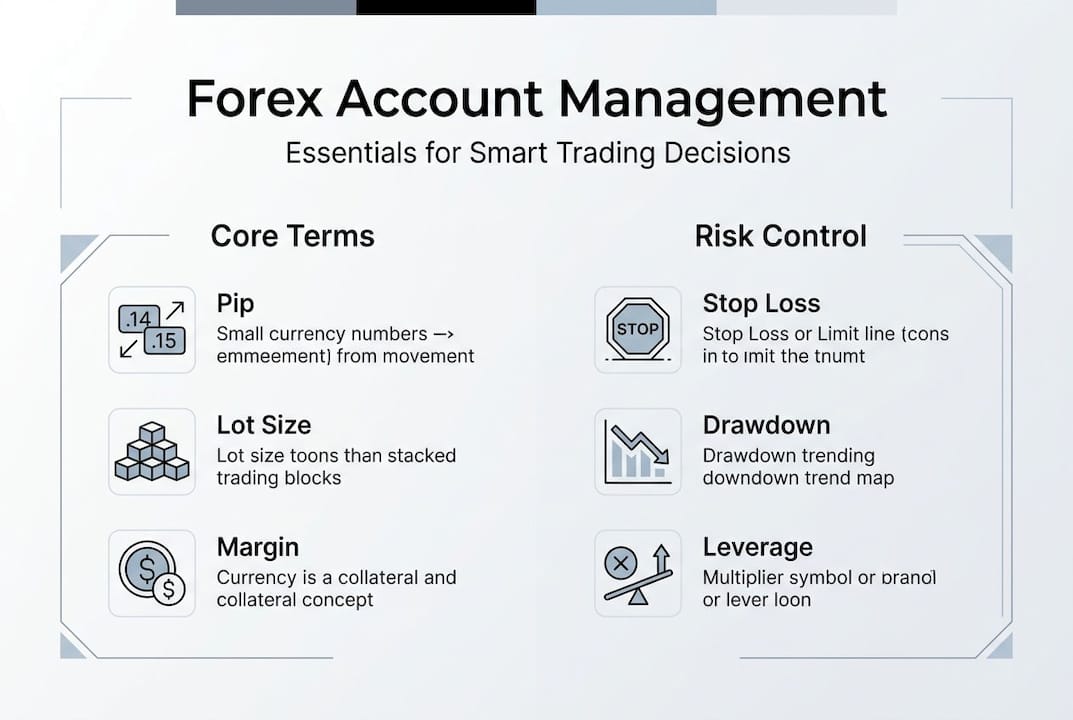
Infographic of core forex terms and risk controls
PAMM pools investor funds into a single master account managed by one trader, with profits and losses distributed by percentage of each investor’s contribution. It is ideal for fund managers handling external capital.
MAM distributes trades across multiple individual accounts with flexible sizing methods including lot-based and equity-based allocation. Unlike PAMM, each sub-account remains independent, giving managers more granular control.
Copy trading automatically replicates trades from a master account to follower accounts in real time. It is the most accessible option for retail traders managing personal accounts or small client groups.
| Method | Best for | Key advantage | Key limitation |
|---|---|---|---|
| PAMM | Fund managers | Pooled capital efficiency | Less individual account control |
| MAM | Account managers | Flexible per-account sizing | Requires broker support |
| Copy trading | Retail traders | Simple setup, real-time replication | Slippage risk across accounts |
When to choose each method:
- Choose PAMM when managing pooled investor capital under a single strategy
- Choose MAM when clients need individual account statements and custom risk levels
- Choose copy trading when you want fast, direct replication across your own accounts
For forex account management optimization, the right allocation method depends on your account diversity. If your accounts vary widely in balance, equity-based sizing prevents smaller accounts from taking disproportionate risk. You can also copy trades from selected MT4 accounts or copy trades between MT5 accounts depending on your platform mix.
Order execution: Slippage, requote, and what affects your fills
With allocation strategies established, let’s address one of the most overlooked yet critical sources of risk in automated trading.
Slippage is the difference between the price you expected and the price you actually got. It happens most often during news events, low liquidity periods, or when your order size is large relative to available market depth. In copy trading, slippage compounds because the same fill delay affects every replicated account.
A requote occurs when your broker cannot fill your order at the requested price and offers you a new one instead. This is common with market makers during volatile conditions. For automated systems, requotes can cause missed entries or unintended position sizes.
Four practical ways to reduce slippage and requote risk:
- Use limit orders instead of market orders when entry precision matters
- Trade during peak liquidity hours, typically the London and New York session overlap
- Choose STP or ECN brokers over market makers for tighter, more consistent fills
- Keep your trade copier on a low-latency VPS close to your broker’s server
Market makers may widen spreads during periods of high volatility, which can increase both slippage and requote frequency. STP and ECN brokers route orders directly to liquidity providers, which generally results in faster fills and more consistent pricing under normal market conditions.
For copy trading execution terms and understanding how managing margin under volatility affects your fills, these concepts are directly connected. A high-leverage account with tight margin buffers is far more vulnerable to slippage-driven losses than a conservatively sized one.
Performance metrics: Drawdown, Sharpe ratio, and measuring success
Once you understand how trades are executed, measuring your performance is the next critical pillar.
Drawdown tells you how much pain your strategy inflicts before recovering. A strategy with a 40% maximum drawdown is not just uncomfortable. It is practically unusable for most clients and prop firm evaluations. The peak-to-trough equity decline is the number every account manager should track weekly.
The Sharpe ratio measures risk-adjusted return. It divides your average return by the standard deviation of those returns. A higher Sharpe ratio means you are earning more return per unit of risk taken. Research consistently shows that live strategy performance tends to lag backtest results — real-world slippage, spread variation, and market regime changes all erode the metrics that looked clean in historical data.
Rules of thumb for using performance metrics in real account management:
- A Sharpe ratio above 1.0 is acceptable; above 2.0 is strong for live trading
- Maximum drawdown should not exceed 20% for client-facing accounts
- Compare live metrics to backtest metrics monthly to detect strategy decay early
- Never evaluate a strategy on fewer than 100 trades; small samples produce misleading Sharpe values
For calculating margin and risk across accounts, these metrics give you the framework to set position limits that keep drawdown within acceptable bounds. Backtests can mislead you if market volatility shifts or if the strategy was overfit to historical data, so always weight live performance more heavily.
Boost your multi-account trading efficiency with automated trade copying
Now that you know the key terms and concepts, here is how you can put them into practice with reliable tools built specifically for multi-account trading.
Local Trade Copier removes the manual errors that come from re-entering trades across terminals. It handles waiting for stop loss or take profit automatically, so your risk management settings replicate exactly as configured. With 18 lot sizing and risk management options, you can apply the right allocation method whether you are running PAMM-style setups or direct copy trading across MT4, MT5, and DXTrade accounts. Follow the trade copier installation guide to get set up in minutes, or watch the trade copier demo video to see sub-0.5-second local execution in action. With 3,000+ users and a 17-day free trial, it is a locally-installed solution that has been actively used since 2010.
Frequently asked questions
What is a pip and why does it matter in forex trading?
A pip is the smallest price movement for most currency pairs, usually 0.0001. Tracking pip changes lets you calculate profit and loss accurately across every open position.
How does leverage work in forex trading?
Leverage lets you control larger positions with less capital. At 1:100 leverage, $1,000 controls $100,000 in currency, which amplifies both gains and losses proportionally.
What are PAMM, MAM, and copy trading solutions?
PAMM pools investor funds under one trader, MAM distributes trades to individual accounts with flexible sizing, and copy trading mirrors a master account automatically in real time.
How can I reduce slippage and requotes when using trade copying solutions?
Use limit orders, trade during peak liquidity hours, and keep your copier on a low-latency VPS. Slippage is most common during news events and low-liquidity conditions.
What does drawdown mean, and how should I use it to manage risk?
Drawdown is the peak-to-trough equity decline caused by losing trades. Use it to set hard risk limits per account and flag strategies that are deteriorating before losses become unrecoverable.
Recommended
- What is forex account management: optimize multi-account trading
- Benefits of Forex Account Management | Local Trade Copier
- Trade copying best practices for efficient forex management
- A Forex Trade Management Strategy To Get More Profit
