

Running multiple prop firm accounts without a system is like juggling live grenades. One missed trade, one duplicate entry, one correlated position too many, and you can breach drawdown limits across every account simultaneously. The traders who scale successfully aren’t necessarily better at reading charts. They’re better at building systems. This guide covers the exact best practices that separate disciplined multi-account operators from those who blow up funded accounts in the first month, from architecture choices to compliance rules to weekly review habits.
Key Takeaways
| Point | Details |
|---|---|
| Start small, scale smart | Begin with one account, add others only after demonstrating consistent results and risk control. |
| Set strict risk limits | Limit each trade to 0.25%-0.50% risk and enforce a global risk cap to prevent collective losses. |
| Use native tools for reliability | Prefer platform-native trade copying features and market orders to ensure fast, low-slippage execution. |
| Diversify to manage risk | Spread your accounts across multiple firms and drawdown models to reduce systemic exposure. |
| Review and adapt regularly | Conduct weekly reviews and update your trade copying playbook to sustain success and discipline. |
Master-follower architecture: The foundation for efficient copy trading
To create a reliable multi-account system, you first need a robust framework. Master-follower architecture is exactly what it sounds like: one master account makes all trading decisions, and one or more follower accounts replicate those decisions automatically. No manual re-entry, no timing gaps, no forgotten positions.
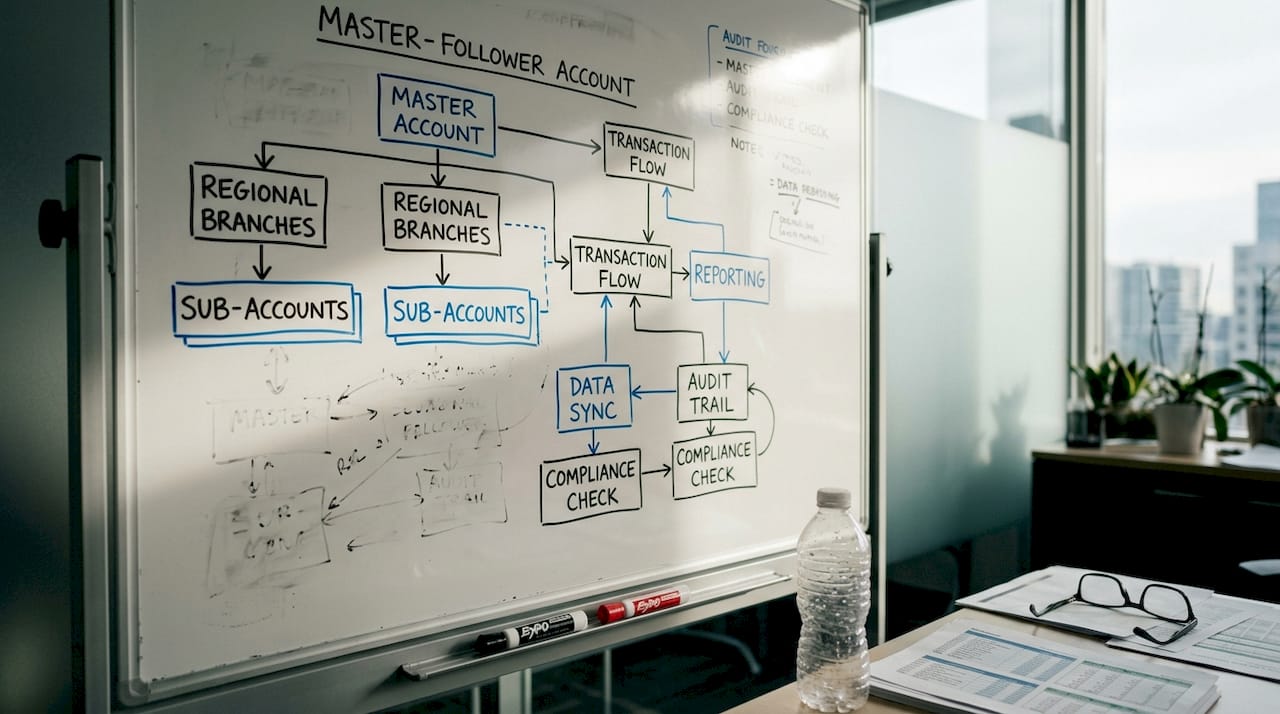
is the primary method for managing multiple prop firm accounts in forex, using a master account for decisions and followers that replicate trades in milliseconds. That speed matters enormously in prop trading, where a two-second delay on a fast-moving pair can mean the difference between a clean fill and a slippage-heavy entry that skews your risk-reward.
The platforms that support this architecture most reliably are MetaTrader 4, MetaTrader 5, and DXTrade. Each allows Expert Advisor-based copying, which means the replication logic runs directly on your machine rather than routing through a third-party cloud server. You can manage prop accounts with trade copying across all three platforms from a single master signal.
Who benefits most from this setup?
- Retail traders running two to five personal funded accounts simultaneously
- Independent account managers copying a single strategy to multiple client accounts
- Prop firm traders who need on-machine execution to avoid triggering cloud IP detection
- EA users replicating one licensed strategy across accounts at different firms
“The master-follower model removes the human bottleneck from multi-account execution. When your edge is in the strategy, not the clicking, automation is the only logical choice.”
Build a scalable setup: Start small, scale gradually
Once you choose your system, you need a deliberate roadmap for growth. The single biggest mistake new multi-account traders make is launching three or four funded accounts at once before they’ve proven consistent performance on even one.
Scale gradually: master one account with two to three payouts, add a second after three to six months, then space additional accounts one to two months apart. This timeline isn’t arbitrary. It gives you time to identify flaws in your strategy before those flaws get multiplied across a portfolio.
Phased scaling and strict per-account risk rules
outperform aggressive multi-account deployment, and 95% of blow-ups stem from correlated risk, not market moves. That statistic should stop you cold. Most traders assume they failed because of a bad trade. The real culprit is usually five simultaneous positions on correlated pairs, all moving against them at once.
Here’s a practical scaling schedule:
- Month 1 to 3: Trade one account only. Achieve two consecutive payouts.
- Month 4 to 6: Add a second account. Keep the same strategy, same risk settings.
- Month 7 to 8: Review both accounts for correlation and drawdown patterns.
- Month 9 onward: Add a third account only if months four through eight show clean performance.
- Month 11 onward: Scale to four or five accounts with one to two months between each addition.
Pro Tip: Track your benefits of forex account management metrics from day one. Knowing your average drawdown per trade and your win rate per session makes scaling decisions data-driven rather than emotional.
Optimize risk management: Per-trade limits and correlation awareness
Scaling requires not just more accounts, but smarter risk controls for every trade. The standard advice of risking one percent per trade breaks down fast when you’re copying the same trade to five accounts simultaneously.
Recommended risk per trade for multi-account setups is 0.25% to 0.50% to account for correlation and prevent collective drawdown breaches. At 0.50% per trade across five accounts, a single losing trade costs you 2.5% of your total funded capital in one shot. That adds up quickly when you’re trading correlated pairs.
Correlation is the hidden risk most traders underestimate. EURUSD and GBPUSD move together roughly 80% of the time. If you’re long both simultaneously across five accounts, you don’t have five separate trades. You have one large directional bet.
Use micros only and avoid contract mixing
; a global risk cap, such as 6R total open risk, prevents overexposure across the portfolio. You can also
optimize multi-account trading
by setting
based on its historical volatility and correlation profile.
| Risk scenario | Accounts | Risk per trade | Total exposure per signal |
|---|---|---|---|
| Conservative | 5 | 0.25% | 1.25% |
| Moderate | 5 | 0.50% | 2.50% |
| Aggressive (not recommended) | 5 | 1.00% | 5.00% |
Pro Tip: Before adding any new pair to your master account, check its 30-day correlation against every pair already in your active rotation. A quick correlation matrix in Excel takes ten minutes and can save you from a portfolio-wide drawdown breach.
Execution excellence: Orders, latency, and native vs. third-party tools
With your risk and scale in check, smooth trade execution is the next hurdle. The order type you use matters more than most traders realize.
Use market orders over limit orders to minimize execution variance; prefer platform-native copying over third-party tools for reliability. Limit orders introduce timing uncertainty. If the master fills but a follower misses the limit level by a fraction of a pip, you end up with mismatched positions across accounts.
Native platform features reduce slippage and latency compared to third-party tools, and you should test on demo for at least 30 days before going live. That 30-day window isn’t just about confirming the copy works. It’s about stress-testing your setup during high-volatility sessions like NFP releases and central bank announcements.
For efficient trade copying, you also want the ability to filter trade types so only specific order categories get replicated, and to copy trades at a better price when slippage conditions allow. Proper allocating account size settings ensure each follower account receives proportional lot sizes relative to its balance.
for 24/5 uptime, and a dedicated VPS outperforms shared hosting for five or more accounts to avoid latency spikes. A shared VPS might work fine during quiet Asian sessions, but during London open with five accounts copying simultaneously, resource contention can add 200 to 400 milliseconds of lag per trade.
| Setup type | Latency | Uptime reliability | Best for |
|---|---|---|---|
| Local PC | Very low | Moderate (power/internet risk) | 1 to 2 accounts |
| Shared VPS | Low to moderate | High | 2 to 4 accounts |
| Dedicated VPS | Very low | Very high | 5+ accounts |
“Every millisecond of latency is a potential pip of slippage. For prop traders with tight drawdown limits, that’s not a rounding error. It’s a risk variable.”
Diversification strategies: Firms, geographies, and drawdown models
A further safeguard is diversification, a key trait of long-surviving traders. Concentrating all your funded accounts at one prop firm is a single point of failure. Firms get acquired, change payout rules, or face regulatory action with little warning.
Diversify across firms, geographies, and account types, including trailing versus end-of-day drawdown models, to mitigate firm-specific risks like glitches or regulatory issues. Trailing drawdown locks in at your highest equity point and follows you down. End-of-day drawdown only resets at the close of each trading day. These two models behave very differently under the same strategy, and mixing them across your portfolio smooths out the variance.
Here’s a stepwise approach to building a diversified prop portfolio:
- Start with two firms in different regulatory jurisdictions.
- Mix drawdown models: one trailing drawdown account, one end-of-day drawdown account.
- Add a third firm only after six months of consistent performance across the first two.
- Vary account sizes across firms to avoid identical position sizing patterns.
- Monitor payout schedules across firms so cash flow is staggered, not lumped.
You can explore multi-account diversification strategies in more depth to structure your portfolio for both performance and resilience.
Pro Tip: Keep a simple spreadsheet tracking each firm’s payout history, rule changes, and any support issues. Patterns emerge over three to six months that tell you which firms are worth scaling with and which ones to phase out.
Compliance and prop firm rules: What you must avoid
Operating at scale also demands tight adherence to prop firm rules. Copy trading is permitted at most prop firms, but only within specific boundaries. Crossing those boundaries, even accidentally, can result in account termination without a payout.
Prohibited behaviors include hedging, cross-owner copying, and identical millisecond executions across many accounts; most firms allow owner-only copying. Cross-owner copying means copying trades from an account owned by one person to an account owned by a different person. Even if both people are in the same household, most firms treat this as a violation.
Here are the key compliance rules to build into your setup:
- Never hedge across accounts at the same firm, even if the accounts are yours
- Copy only between your own accounts, not to accounts owned by others
- Avoid identical entry timestamps across five or more accounts, as this flags automated detection systems
- Read each firm’s terms before adding a new account to your copy chain
- Disable copying during restricted trading windows, such as around major news events if your firm prohibits it
“Compliance isn’t optional at scale. One flagged account can trigger a review of all your accounts at the same firm. Build the rules into your system, not just your memory.”
Routine review and discipline: Continuous improvement habits
Staying competitive isn’t just about setup. It’s about your ongoing habits. The traders who sustain multi-account performance over years aren’t necessarily smarter. They’re more consistent in their review process.
Weekly reviews, correlation scans, and playbook updates maintain discipline, and emotion overrides cause most failures. That last point is worth sitting with. Most multi-account blow-ups aren’t technical failures. They’re moments where a trader overrides their own rules after a losing streak.
Here’s a practical weekly review checklist:
- Review all open positions for unintended correlation across accounts
- Check drawdown levels on every account against their respective limits
- Scan for rule changes at each prop firm you’re active with
- Update your playbook if any session showed unexpected behavior from your strategy
- Log emotional decisions separately from system-generated trades to identify patterns
Pro Tip: Set a fixed 30-minute block every Sunday to run through this checklist before the week opens. Traders who review on a schedule make fewer reactive decisions during live sessions.
Boost your multi-account prop trading with Local Trade Copier
Applying these best practices manually across multiple terminals is exactly the kind of friction that leads to errors. The right tool removes that friction entirely.
is a locally installed Expert Advisor that copies trades across MT4, MT5, and DXTrade accounts in under 0.5 seconds, with no cloud routing and no external server latency. All trade data stays on one machine, one IP address, which is critical for prop firm compliance. It includes 18 lot sizing and risk management options, automatic lot scaling per account balance, and cross-platform copying under a single subscription. Setup is straightforward with the
Local Trade Copier installation
guide, and you can review trade copying best practices to configure your system for maximum efficiency. With 3,000+ users and 491 Trustpilot reviews since 2010, it’s the most established locally-installed copier available. A 7-day free trial lets you test the full setup before committing.
Frequently asked questions
What is the safest risk per trade when copying across prop accounts?
The recommended risk per trade for multi-account setups is 0.25% to 0.50% per trade to prevent collective drawdown breaches across correlated positions.
How do I minimize latency and slippage when trade copying?
Use market orders and native platform copy features to reduce execution variance, and run your setup on a dedicated VPS if you’re copying to five or more accounts.
Which copying behaviors can get my prop accounts banned?
Common violations include hedging, cross-owner copying, and identical millisecond executions across accounts. Most firms permit copying only between accounts you personally own.
How often should I review my multi-account portfolio?
Weekly reviews that include correlation scans and playbook updates are the minimum standard for maintaining discipline and catching problems before they compound.
Recommended
- Trade copying best practices for efficient forex management
- How to Copy Trades Between Two or More MT5 Trading Accounts
- How to manage prop trading accounts with trade copying
- Ghost trades in copy trading and how to remove them
- Mithril Money – Automated Trading Strategies & DeFi Tools
