

TL;DR:
- Automation is essential for prop trading firms to minimize human error and ensure real-time risk compliance across multiple accounts. It enforces strict rule adherence, reduces execution risks, and improves operational safety through automatic monitoring and control. Proper implementation, continuous review, and skilled oversight are crucial to leverage automation’s full benefits effectively.
Prop trading runs on razor-thin timing and strict rule compliance. One missed execution or a single accidental drawdown breach can wipe out a funded account and trigger a costly review process. Human error is a well-documented source of avoidable trading losses, and in multi-account environments the exposure compounds fast. Automation is no longer optional for prop firms that want to stay competitive, protect client capital, and meet increasingly demanding institutional standards. This guide walks through why automation matters and exactly how to implement it across your operations.
Key Takeaways
| Point | Details |
|---|---|
| Manual trading risks | Manual management leads to errors, delays, and compliance breaches across prop accounts. |
| Real-time risk controls | Automation enforces rule-based risk limits instantly, reducing human error and exposure. |
| Execution reliability | Automated solutions mitigate latency, disconnects, and order-handling errors for consistent results. |
| Ongoing system vigilance | Effective automation demands continuous monitoring, updates, and adaptive safeguards. |
The core challenges of manual account management
Running multiple prop accounts by hand is exhausting and inherently risky. Even skilled traders make timing errors, miscalculate lot sizes, or forget to close positions before session cutoffs. When you are managing several accounts simultaneously, the probability of at least one mistake climbs dramatically. Good account management tips stress this point repeatedly: the more accounts you handle manually, the more exposure you carry.
The specific pain points that come up most often include:
- Missed trade entries or exits during fast-moving market conditions
- Inconsistent lot sizing when copying trades manually between terminals
- Delayed response to news events or sudden price gaps
- Accidental rule violations when drawdown limits are not tracked in real time
- Cascading errors where one misjudged position in a master account spills uncontrolled into sub-accounts
That last point deserves emphasis. In a multi-account setup without automation, one bad call in the master can quickly ripple across every linked account before a human manager even notices. By the time corrective action is taken, the damage is already done across the board. That is the kind of risk that increasingly concerns oversight-minded stakeholders in multi-account environments.
The compliance dimension is equally serious. As covered in the prop firm account management tips, prop firms operate under increasingly firm-specific rules around maximum daily drawdowns, profit targets, and position limits. Manual tracking of these parameters in real time simply does not scale. And risk mitigation strategies that rely on a trader remembering to check a dashboard before placing a trade are strategies waiting to fail.
Manual management is not just inefficient. It is structurally unsafe for any firm running at scale.
How automation safeguards risk and compliance
The moment you introduce rule-based automation, the character of your risk exposure changes completely. Instead of relying on a trader to remember the firm’s daily loss limit, the system enforces it automatically. The moment a pre-set threshold is breached, the platform pauses new trades or locks the account outright, with no human reaction time required.
Here is a direct comparison that shows why this matters:
| Risk control area | Manual process | Automated system |
|---|---|---|
| Drawdown enforcement | Trader checks balance manually | Triggered instantly at the threshold |
| Session lockout | Human sets a reminder or alarm | Enforced on the second the session ends |
| Max lot compliance | Trader calculates position size | System rejects oversized orders automatically |
| Audit trail | Manually logged (inconsistent) | Every event is time-stamped and logged automatically |
| Error rate | High (increases with fatigue) | Near-zero for rules already programmed |
| Response speed | Seconds to minutes | Milliseconds |
The difference is not marginal. It is the difference between a defensible compliance record and a paper trail full of gaps. Automated systems also make your prop firm trading checklist far easier to follow consistently, because the system is enforcing the rules regardless of how distracted or stressed the trader is.
For account managers running multiple funded accounts under risk strategies for prop firms, automated controls also reduce the liability exposure that comes with managing third-party capital. When something goes wrong, you have a full automated log proving the system responded correctly within milliseconds. That is a very different conversation than trying to explain why a human missed a breach.
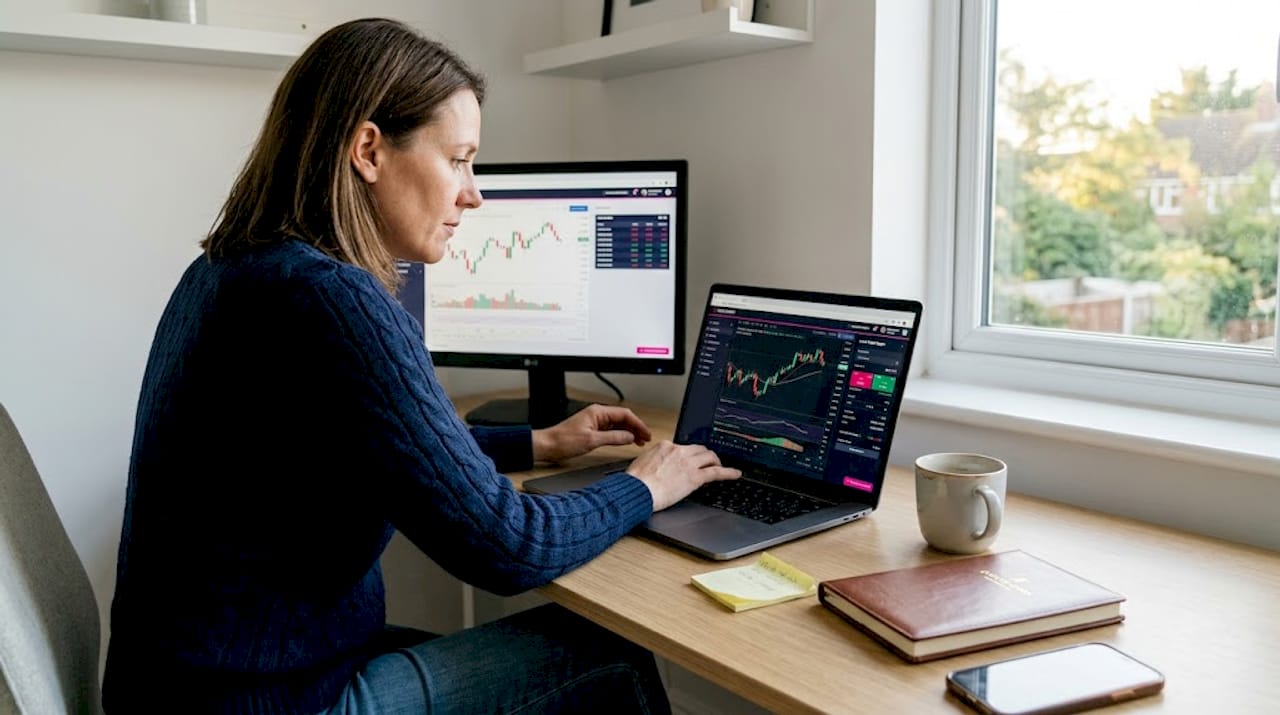
Trading manager reviewing automated accounts
Applying automation to multi-account copying best practices also means per-account risk rules can be configured independently. A higher-risk developmental account can have tighter drawdown limits than a more stable live account, and the automation handles both simultaneously without additional management overhead.
Pro Tip: Configure per-account drawdown limits before you go live with any copying setup. As a general practice, some traders configure their automation thresholds below the firm’s stated maximum to allow a correction window, though the appropriate margin will depend on each firm’s specific rules and the trader’s risk profile. This approach demonstrates proactive risk management to oversight bodies.
Automation’s role in eliminating execution risks
Even if you have solid risk rules in place, execution risk is a separate and equally dangerous category. In high-frequency multi-account environments, the technical gap between “trade triggered” and “trade filled” can create serious inconsistencies across accounts. Without automation handling this layer, latency jitter, disconnects, and fill mode differences quietly erode the edge you think you have.
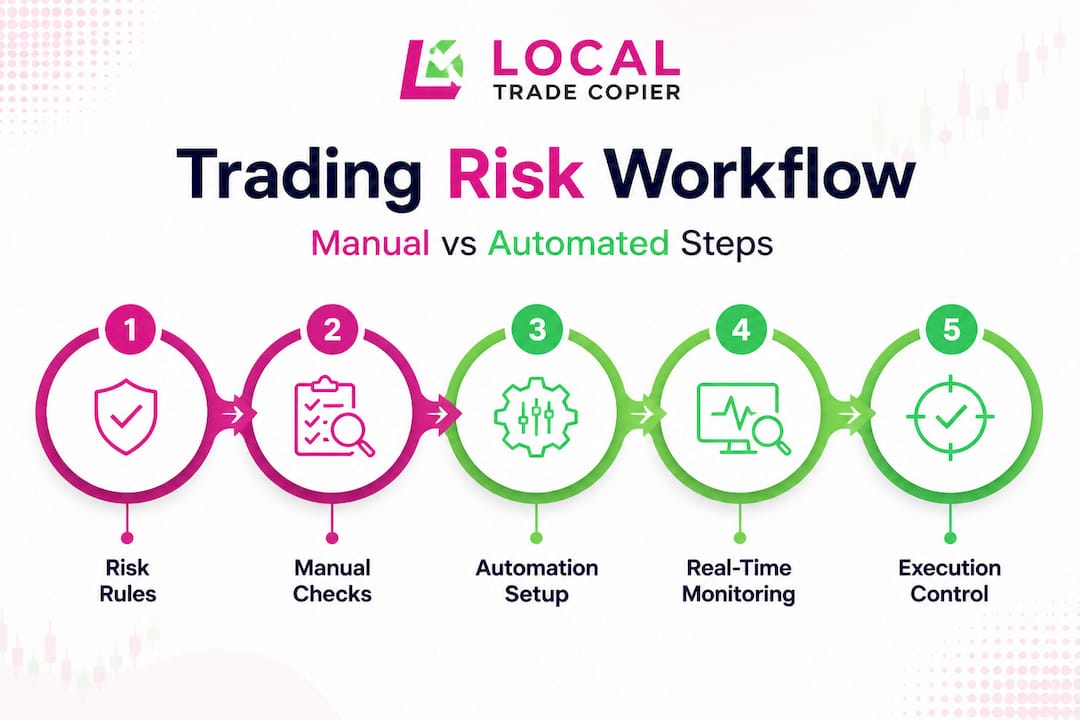
Vertical workflow comparing manual and automated steps
Here is a breakdown of the most common execution risks and how automation addresses each one:
| Execution risk | What it causes | Automation solution |
|---|---|---|
| Network latency | Different fill prices across accounts | Sub-0.5-second local execution |
| Broker disconnects | Silent execution failures | Health checks and auto-reconnect protocols |
| Fill mode differences | Inconsistent order types between platforms | Per-symbol order-type configuration |
| Order queue delays | Missed entries during news spikes | Direct local processing without cloud routing |
| Partial fills | Mismatched position sizes across accounts | Automated lot scaling and reconciliation |
Each one of these failure modes can cost real money. And they are almost impossible to catch manually in real time when you are managing more than two or three accounts.
Here is a practical numbered sequence for implementing automated execution safely:
- Audit your current setup. Map every account, platform, and manual step in your current workflow. Identify where execution gaps are most likely to occur.
- Choose a local copier solution. Local execution keeps all trade data on one machine and one IP address, which also protects prop firm accounts from cloud IP detection issues.
- Configure per-symbol order handling. Not all instruments behave the same way across brokers. Set order types specifically for each symbol to avoid fill inconsistencies.
- Set up health checks. Make sure your software monitors the connection status of every terminal continuously and alerts you instantly when a disconnect occurs.
- Run simulated stress tests. Deliberately introduce lag, simulate a disconnect, and verify that your automation handles it the way you expect before going live.
- Document everything. Log your configuration settings, test results, and any anomalies. This is your safety record if questions arise later.
For traders wanting a deeper look at practical workflows, the article on best copy trading setup gives step-by-step guidance specific to fast-moving scalping environments. You can also explore how to automate MetaTrader trading for a broader view of platform-level automation options.
Pro Tip: Always configure a kill switch within your automation setup. A kill switch instantly closes all open positions across every account the moment a critical threshold is hit. Combine it with a scheduled software update protocol so your system never runs on outdated parameters. Treat these two items as non-negotiables before going live.
Consulting a solid forex risk management guide alongside your automation setup gives you the human-side context that pure software configuration cannot replace.
Best practices for implementing automation in prop firms
The implementation approaches below are provided for general reference. Outcomes depend on individual configuration, broker conditions, and market circumstances.
Knowing that you need automation is one thing. Knowing how to roll it out without creating new problems is another. The firms that get this right treat implementation as a structured project, not a plug-and-play installation.
Start by evaluating which accounts genuinely need strict automation first. High-volume accounts, rule-sensitive funded accounts, and any account managed on behalf of third-party capital should be your first priority. Lower-volume personal accounts can follow once you have validated the workflow. This staged approach limits your exposure during the transition period.
Real-time monitoring is not optional. Look for real-time monitoring engines and rule execution with drawdown monitoring built into your chosen platform. If your system cannot alert you within seconds of a rule event, it is not good enough for serious prop trading operations.
Here are the do’s and don’ts every prop firm should post to their implementation checklist:
Do:
- Test the full workflow in a demo environment before connecting live accounts
- Configure independent risk parameters per account, not just globally
- Schedule weekly system audits to confirm rules are still aligned with firm requirements
- Train every team member who touches the system on escalation procedures
- Keep a written runbook for common failure scenarios and their resolution steps
Don’t:
- Assume automation eliminates all human responsibility
- Skip the stress-testing phase because the demo results looked clean
- Use the same lot sizing rules across accounts with very different balances
- Delay software updates because the current version “seems to be working fine”
- Ignore connection health warnings as minor issues
The smart trade copying advantages available today make it genuinely possible to manage five, ten, or even more accounts with the same discipline you would apply to one. But that benefit only materializes when the implementation itself is solid. Use a prop firm trading checklist to make sure nothing gets overlooked before you flip the switch to live.
Staff training matters more than most managers expect. The automation handles the execution, but humans still set the rules, respond to escalations, and make judgment calls when conditions fall outside the programmed parameters. Standardized escalation procedures ensure that every team member knows what to do when the automation flags something unusual, rather than improvising under pressure.
The uncomfortable truths about automation in prop firms
Here is what most guides will not tell you outright: automation creates a false sense of security faster than almost any other tool in trading. Firms install a trade copier or risk management system, confirm it is working, and then quietly shift their attention elsewhere. Six months later, the rules inside the system no longer match the firm’s current requirements, and nobody noticed because the software kept running without complaint.
Automation is only as current as your last review. Markets change, broker terms change, and prop firm rules change. A system configured for last year’s drawdown limits is not protecting you this year. This is the operational discipline that separates firms that sustain long-term performance from those that hit a crisis and realize their “automated” controls were actually dormant.
There is also a subtler issue. Traders who rely entirely on automation sometimes stop developing the manual judgment that catches what algorithms miss. No system perfectly anticipates every edge case. When conditions fall genuinely outside the programmed parameters, you need a trader who understands the underlying risk logic, not someone who just knows how to click the start button.
The real edge with automation comes from the interplay between algorithmic discipline and active human oversight. Think of automation as enforcing the rules you already believe in, faster and more consistently than you can manage by hand. Then think of yourself as the person who continuously improves those rules based on new data, new market conditions, and honest post-mortems of what the system did and did not catch.
For firms ready to operationalize this mindset, exploring smarter multi-account solutions is the natural next step. The tools exist to handle the execution layer with precision. The ongoing challenge is staying engaged with those tools rather than treating them as a problem already solved.
Ready to automate? Explore prop firm trade copying solutions
The gap between manual chaos and disciplined automated execution is smaller than most traders expect, but only if you choose the right tool and implement it correctly.
Local Trade Copier is purpose-built for exactly this environment. It runs entirely on your local Windows machine or VPS, keeping your trade data on one IP address with no cloud routing risk. Speed of 1 second or faster under normal market conditions, eight money management modes, and cross-platform support across MT4, MT5, and DXTrade make it a comprehensive locally-installed solution. Review the multi-account trade copying best practices to see how it fits your setup. Explore how stop loss and take profit replication works in live environments, and learn why VPS security is a critical part of any serious automated prop trading operation. Start your 7-day free trial and see the difference local execution makes.
Frequently asked questions
What are the main risks of managing prop firm accounts manually?
Manual management risks accidental rule breaches, slower execution, and costly compliance failures due to human error. Without automated controls, a single misjudged position can cascade across multiple accounts before any correction is possible, as rule violations can spread rapidly in multi-account setups.
How does automation enforce trading limits in real time?
Automated tools instantly pause trading or lock accounts the moment pre-set risk limits like drawdowns or profit targets are breached. The enforcement happens in milliseconds, far faster than any manual monitoring process.
What execution failures does automation help prevent?
Automation tackles issues like latency, disconnects, and order-handling errors that undermine trade replication and consistency. These execution edge cases are especially damaging in high-frequency or multi-account environments where timing differences compound quickly.
Is automation a set-and-forget solution for prop firms?
No. Continued monitoring, regular updates, and periodic stress-testing are essential to maintain operational safety and reliability. Systems that are configured once and left unreviewed quickly fall out of alignment with current firm rules and market conditions.
Are automated solutions suitable for all forex prop accounts?
Most accounts can benefit, but it makes practical sense to prioritize automation for high-volume and rule-sensitive accounts first. Once you have validated the workflow on critical accounts, extending automation to lower-risk accounts becomes straightforward and low-risk.
Recommended
- Essential risk mitigation strategies for prop firm traders
- Prop Firm Account Management Tips: Maximize Efficiency
- Why professional traders rely on automation: 92% of Forex
- Your ultimate prop firm trading checklist for better results
- Master forex risk management: a step-by-step guide – DayProp Funding
