
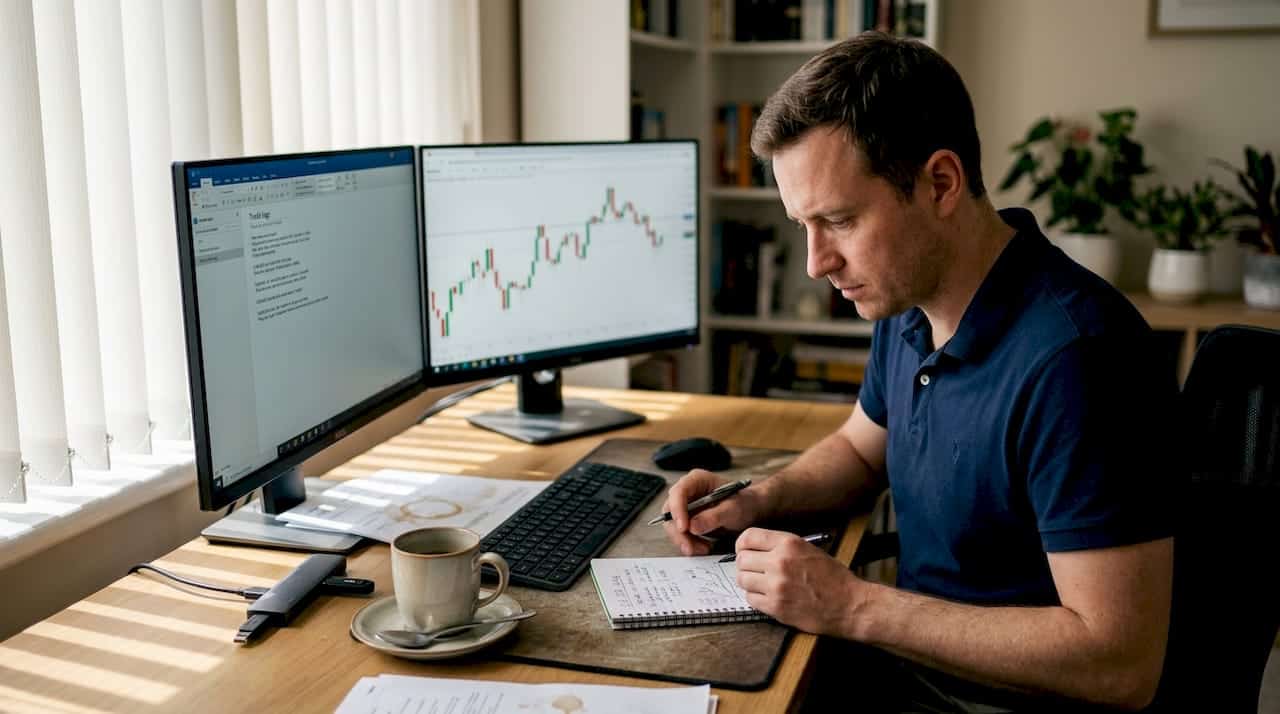
Most retail traders assume professionals spend their days watching charts and clicking buy or sell. The reality is strikingly different. 92% of Forex volume is now algorithmic, meaning automation isn’t a shortcut or a luxury. It’s the foundation of how serious traders operate. Manual execution simply can’t compete with the speed, consistency, and scalability that automated systems deliver. This article breaks down what automation really means for professional traders, how multi-account execution works in practice, and where human judgment still matters.
Key Takeaways
| Point | Details |
|---|---|
| Automation drives execution | Professional traders use automation to achieve fast, precise trade execution and minimize emotional decisions. |
| Multi-account scalability | Trade copiers enable reliable, simultaneous trading across hundreds of accounts with minimal latency. |
| Empirical benefits | Data shows that automated trading consistently outperforms manual strategies in speed and risk control. |
| Pitfalls and adaptation | Automation is not flawless; professionals mitigate risks through testing, monitoring, and hybrid approaches. |
| Next steps: Solutions | Trade copier tools make professional-grade automation accessible to both retail traders and account managers. |
What automation means for professional traders
Automation in trading means using pre-programmed rules to enter, manage, and exit trades without manual input. These rules are built into Expert Advisors (EAs) running on platforms like MetaTrader 4 (MT4) or MetaTrader 5 (MT5). The EA monitors the market continuously, applies your strategy logic, and fires orders the moment conditions are met.
For professionals, this unlocks three things that manual trading can’t reliably provide:
- Speed: Automated systems execute in milliseconds, while a human reaction takes hundreds of milliseconds at best.
- Precision: Every trade follows the same rules, every time. No second-guessing, no hesitation.
- Scalability: One strategy can run across dozens of accounts simultaneously without adding workload.
The forex account management benefits of automation become especially clear when you’re managing client funds. A single delayed execution or missed stop-loss can erode trust and capital.
| Feature | Manual trading | Automated trading |
|---|---|---|
| Execution speed | Seconds | Milliseconds |
| Emotional influence | High | None |
| Scalability | Limited | Scales to plan limits |
| Consistency | Variable | Fixed by rules |
| Risk control | Manual | Pre-programmed |
“Professional traders use automation for speed, emotion-free trading, scalability, and consistent risk management across every market condition.”
Replication under 0.5 seconds across accounts is achievable with locally installed systems. That’s the kind of edge that separates professional-grade execution from retail guesswork. Understanding this is step one. The trade copying best practices that follow build directly on this foundation.
Mechanics: How automation empowers multi-account trading
Knowing automation is fast is one thing. Understanding how it works across multiple accounts is where the real operational value lives.
At the core, an EA on MT4 or MT5 applies pre-defined rules for entry and exit based on technical indicators, price action, or even machine learning models. Layered beneath that are data feeds, risk controls, and monitoring systems that keep everything running without manual oversight.
For multi-account managers, the key component is a trade copier. A trade copier takes every action on a master account and replicates it instantly across client accounts. Trade copiers replicate signals simultaneously with lot scaling, meaning each client account receives a proportional position based on their balance or a fixed lot setting you define.
Here’s how the two workflows compare:
| Step | Manual multi-account | Trade copier workflow |
|---|---|---|
| Trade signal | Trader identifies manually | EA fires automatically |
| Order entry | Repeated per account | Copied instantly |
| Lot sizing | Calculated manually | Auto-scaled per account |
| Monitoring | Constant attention | Automated alerts |
Setting up automated multi-account execution follows a clear sequence:
- Install your EA on the master MT4 or MT5 account.
- Configure your strategy parameters, risk limits, and lot sizing rules.
- Install the trade copier on the same machine or VPS.
- Link client accounts as receivers with individual lot scaling settings.
- Run a forward test before going live to confirm replication accuracy.
For a practical walkthrough, the FX account cloning setup guide covers the full process. You can also see a copy trades MT4 master example with three client accounts to understand real-world scaling. If you need remote access, managing MT4 accounts remotely is fully supported through VPS configurations.
Pro Tip: Always forward-test your setup for at least two weeks on a demo before pushing live client accounts. Backtest results don’t account for real-world slippage or feed interruptions.
Benefits proven by data: Speed, stability, and risk control
The case for automation isn’t just theoretical. The numbers back it up consistently.
92% of Forex volume is algorithmic, and that concentration reflects where performance actually lives. Research suggests that execution quality improvements from automation can contribute to better risk-adjusted returns, though outcomes vary significantly by strategy, market conditions, and implementation. No performance advantage is guaranteed.
For retail traders and account managers, the practical benefits stack up quickly:
- Reduced latency: Orders reach the broker in milliseconds, not seconds.
- Eliminated emotional bias: Fear and greed don’t interfere with rule-based execution.
- Consistent risk application: Stop-loss and position sizing rules apply identically every trade.
- Scalability without overhead: Adding a new client account doesn’t add manual workload.
- Error reduction: Automation reduces latency and errors, which is critical for prop firm and funded account scaling.
Trading involves risk of loss. Execution speed and consistency improvements from automation do not guarantee profitable outcomes. Past performance of any trading approach is not indicative of future results.
For traders running funded or prop firm accounts, execution quality is especially important. A single fat-finger error or delayed exit can trigger a drawdown breach. Automation removes that risk entirely from the execution layer.
Account manager checking trading results on laptop
If you want to push performance further, optimizing your MetaTrader performance covers the technical settings that affect execution speed and stability at the platform level.
Pitfalls and misconceptions: Automation isn’t magic
Here’s where many traders get burned. They assume automation means set-it-and-forget-it. It doesn’t.
The most common failure mode is over-optimization, or curve-fitting. A strategy backtested on five years of data can look flawless while being completely useless live. The algorithm learned the noise, not the signal. When market conditions shift even slightly, the strategy collapses.
Strategy decay is the second major risk. Markets evolve. Liquidity patterns change. Central bank behavior shifts. An algorithm that worked in 2022 may underperform badly in 2026 without updates.
Common pitfalls every account manager should know:
- Over-optimization: Backtest performance doesn’t guarantee live results.
- API and platform outages: Tech failures can leave positions unmanaged at critical moments.
- No monitoring: Assuming the system runs itself leads to missed errors.
- Ignoring regime shifts: Bull, bear, and ranging markets require different logic.
- Skipping forward testing: Backtests are historical. Forward tests are real.
Hybrid quant-discretionary approaches have proven more resilient during market crises precisely because human judgment can override a failing algorithm when conditions are genuinely unusual.
Pro Tip: Run a 3 to 6 month forward test before committing real capital. Use randomized input variations to stress-test robustness. If the strategy only works with one specific parameter set, it’s over-fitted.
For a structured approach to avoiding these issues, best automation practices outlines the workflows that keep automated systems reliable over time.
Hybrid approaches: Automation and discretionary trading combined
Fully automated trading works well in stable, trending, or range-bound conditions. But markets don’t always cooperate. Flash crashes, geopolitical shocks, and central bank surprises create environments where rigid algorithms can amplify losses rather than contain them.
This is why algos can amplify volatility in stress regimes, and why experienced professionals increasingly blend automation with discretionary oversight. AI and machine learning models are now being layered on top of rule-based systems to improve adaptability, but even those require human review during extreme events.
Hybrid advantages for professional traders include:
- Crisis management: A human can pause or override an algorithm during a flash crash.
- Regime detection: Discretionary judgment identifies when market character has shifted.
- Strategy refinement: Manual review of automated performance leads to better rule updates.
- Reduced tail risk: Human oversight catches edge cases that algorithms weren’t trained on.
“Discretionary trading excels in uncertainty, while automation handles routine execution. The strongest trading operations combine both.”
For account managers using trade copiers, the hybrid model is straightforward. Automate routine execution and lot scaling. Keep manual override available for news events or unusual volatility. The clone forex accounts setup supports this by letting you pause copying at the master level without disrupting individual client account settings.
The real secret: Staying adaptive with automation
Here’s something most automation guides won’t tell you: the traders who get burned by automation aren’t the ones who used it. They’re the ones who stopped thinking once they turned it on.
The real professional edge isn’t having a great algorithm. It’s treating automation as a living system that needs regular review, stress-testing, and occasional human intervention. Markets are not static. A strategy that performs well for six months can quietly degrade over the next three if nobody is watching.
This pattern has been documented across algorithmic trading literature since automated strategies became widespread. Traders who thrive long-term are the ones who combine robust automated execution with genuine market awareness. They review performance weekly. They update parameters when conditions shift. They don’t confuse automation with abdication.
“Automation is a tool, not a substitute for judgment. The edge comes from knowing when to trust the system and when to step in.”
The forex automation insights that matter most aren’t about which EA to run. They’re about building a review process that keeps your automation aligned with current market reality. That’s the discipline that separates professionals from people who just run EAs.
Enhance your account management efficiency with trade copier solutions
If the mechanics and benefits covered here resonate with how you manage accounts, the next step is straightforward. Local Trade Copier gives you sub-0.5-second local execution across MT4, MT5, and DXTrade accounts, with 18 lot sizing and risk management options built in. No cloud routing, no external latency, and no IP exposure for prop firm accounts.
](https://csuxjmfbwmkxiegfpljm.supabase.co/storage/v1/object/public/blog-images/organization-20479/1773294400737_mt4copier.jpg)
You can explore the full trade copier installation guide to see exactly how setup works, or watch the trade copier demo video to see replication in action. If you want to understand how stop-loss and take-profit handling works during copying, the trade copier SL/TP documentation covers every scenario. A 17-day free trial is included with every subscription.
Frequently asked questions
Why do professional traders prefer automation over manual trading?
Automation delivers speed, emotion-free execution, and consistent risk management that manual trading simply cannot replicate at scale. It also allows a single strategy to run across multiple accounts simultaneously without additional workload.
How do trade copiers help account managers automate trading across multiple accounts?
Trade copiers replicate signals simultaneously from a master account to all linked client accounts, with automatic lot scaling based on each account’s balance or a fixed setting. This eliminates manual re-entry and ensures synchronized execution with minimal delay.
Are there risks in relying entirely on trading automation?
Yes. Over-optimization causes live failure even when backtests look perfect, and API outages or strategy decay can erode performance without warning. Pairing automation with regular monitoring and human discretion is essential.
Do hybrid trading methods outperform fully automated systems during market crises?
Hybrid quant-discretionary approaches consistently show more resilience during volatile or uncertain market conditions because human judgment can override algorithms when conditions fall outside their training range.
What are best practices for testing automated trading strategies?
Conduct 3 to 6 months of forward testing before going live, apply randomized input variations to check robustness, and monitor for market regime shifts that may require strategy updates. Backtests alone are not sufficient validation.
Recommended
- How to automate forex trading with MetaTrader platforms
- Algorithmic Trading in Forex: Automating Your Success
- Optimize automated trading workflow: forex replication guide
- Forex Robots: Advantages and Disadvantages
