
TL;DR:
Secure trade sharing is essential for Forex traders managing multiple accounts, as compromised information can lead to devastating losses. Using regulated platforms, strong authentication, encrypted communication, and platform-native tools helps prevent unauthorized access and leaks. Implementing regular audits, small test transactions, and secure data practices ensures ongoing protection against common vulnerabilities.
Knowing how to share trades securely is not optional for anyone managing multiple Forex accounts, onboarding clients, or running an education service. A single intercepted message containing login credentials, API keys, or trade details can wipe out accounts you have spent years building. The threat is not theoretical. Traders routinely share sensitive information over WhatsApp, Telegram, or unencrypted email without realizing those channels offer almost no protection against a determined bad actor. This guide walks you through exactly what to do before, during, and after sharing trade information so that nothing leaks that should not.
Key Takeaways
| Point | Details |
|---|---|
| Authentication first | Set up app-based 2FA or hardware keys before sharing any trade data across accounts. |
| Never go off-platform | Keep all trade conversations inside regulated, licensed platforms to retain security protections. |
| Split sensitive data | Send the link via one channel and the password via another to cut exposure risk dramatically. |
| Verify before scaling | Run a small test transaction with any new counterparty before sharing full trade details. |
| Audit and alert always | Turn on account alerts and review trade confirmations regularly to catch unauthorized activity early. |
Setting up for secure trade sharing
Before you share a single trade detail with anyone, your foundation needs to be solid. That means licensed platforms, strong authentication, and a secure network. Skipping this step is where most traders create vulnerabilities without knowing it.
Use licensed and regulated platforms
Not every platform that calls itself a “trade copier” or “account manager portal” operates under proper regulatory oversight. Stick to platforms and brokers that are licensed by recognized authorities. Beyond compliance, regulated platforms require structured safeguards that unregulated ones simply do not enforce. If a platform does not display licensing information clearly, that is your answer.
Authentication: go beyond a password
App-based 2FA or hardware keys like FIDO2 tokens offer significantly stronger protection than SMS-based verification. SMS codes can be intercepted via SIM-swapping attacks. Time-based one-time passwords (TOTP) from an authenticator app are harder to intercept and cost nothing to set up. Hardware keys are the strongest option available for high-value accounts.
Here is a quick reference for the tools you should have in place before sharing any trade information:
| Tool | Purpose | Security level |
|---|---|---|
| Authenticator app (TOTP) | Account login protection | High |
| FIDO2 hardware key | Login and transaction approval | Very high |
| VPS on dedicated IP | Isolated execution environment | High |
| Zero-knowledge note service | Sharing sensitive data temporarily | High |
| Encrypted messaging app | Communication with counterparties | Moderate to high |
The role of a VPS
A Virtual Private Server gives your trading software a dedicated, isolated environment that does not share resources with other users. All trade execution and data flow through one machine with one IP address. There is no cloud routing exposure, no shared session risks, and no third-party server touching your positions. For prop firm traders especially, this matters because cloud-routed trade copiers can trigger IP flag issues with broker compliance systems.
Pro Tip: Lock your VPS login with a unique, long passphrase and disable password-based SSH login entirely. Use key-based authentication only.
Step-by-step methods to protect trade data
Safe methods to share trades come down to a clear process. Each step below removes a specific vulnerability.
- Never use standard messaging apps for sensitive trade data. WhatsApp, Telegram, and standard email are convenient but not built for securely sending trade information like account numbers, API keys, or position sizes. Even “encrypted” general-purpose messengers retain metadata and message histories that can be subpoenaed or hacked.
- Use a zero-knowledge, self-destructing note service. Services that generate a one-time link containing your sensitive data delete that data the moment the recipient opens it. Split sensitive data across two separate channels: send the note link through one channel and the access password through a completely different one. If one channel is compromised, the attacker still cannot read the note without both pieces.
- Leverage platform-native escrow and trade sharing links. Many regulated P2P and copy-trading platforms have built-in sharing mechanisms. Escrow systems on reputable platforms lock the relevant assets or confirmation until both parties verify the trade. Using these features keeps the transaction inside the platform’s security perimeter rather than out in the open.
- Verify counterparties before you share anything meaningful. Check their account history, reviews, or verification status directly on the platform. Do not accept verification proof sent to you via external channels. Screenshots can be faked; platform-native status badges cannot.
- Conduct a small test transaction first. Verifying counterparties with trial trades before scaling up is one of the most practical trade sharing security tips you can follow. A bad actor will often reveal inconsistencies during a small, low-stakes test that they would not reveal otherwise.
- Confirm the transaction through the platform before releasing anything. Do not trust a screenshot of a completed trade. Confirm directly inside the platform interface that the action is fully recorded and settled.
Pro Tip: When onboarding a new client as an account manager, create a shared checklist covering authentication setup, platform verification, and test-transaction completion before any live copying begins. It takes 20 minutes and eliminates most early security gaps.
Common mistakes that expose trade data
Understanding where traders go wrong is just as useful as knowing what to do right. These are the most frequent security failures in trade sharing.
- Moving conversations off-platform. A counterparty asking to “continue this on Telegram” is a major red flag. Off-platform communications remove you from the platform’s dispute resolution and security protections entirely. Once you leave, you have no recourse.
- Sharing API keys carelessly. An API key with trading permissions is essentially a password to your account. Sharing it over email, screenshots, or chat is the equivalent of handing a signed blank check to a stranger. Always use read-only API keys unless write access is absolutely required, and rotate them after any sharing event.
- Trusting screenshots as proof. Screenshots of balance confirmations, trade receipts, or account verifications can be edited in minutes. Never use a screenshot as the sole basis for confirming a trade or releasing funds.
- Using unregulated middlemen or signal services. There is a large market of signal providers and “account managers” who operate without regulatory licenses. Handing trade access to an unregulated middleman exposes your account to both fraud and liability with no protection if something goes wrong.
- Ignoring account alerts. Most brokers and trading platforms allow you to configure real-time alerts for logins, withdrawals, and trade executions. Skipping account alerts means unauthorized activity can go undetected for days or weeks.
- Storing live trading tokens inside AI tools. If you use automated or AI-assisted trade management tools, keep real brokerage tokens outside those environments. Real brokerage tokens in AI agents create leakage risk if the agent’s environment is ever compromised. Require human approval for any live trade execution.
Security in trade sharing is not about paranoia. It is about removing the low-effort opportunities that allow bad actors to succeed. Most breaches happen not from sophisticated attacks, but because something convenient was chosen over something secure.
Verifying trades after sharing them
Sharing the trade is only half the process. Confirming it arrived correctly and was not tampered with is the other half.

Trader confirming trade with paper logbook and laptop
Set up real-time account alerts
Configure your broker platform to send immediate notifications for every login, every trade opened or closed, and every withdrawal request. Account alerts and auditing are one of the most reliable defenses against unauthorized activity. If you see an alert for something you did not authorize, you can act within minutes rather than discovering the problem days later.
Use immutable audit trails
Some platforms and tools support blockchain-based verification, where a cryptographic proof of a trade record is stored on-chain while the sensitive details remain off-chain. Hybrid blockchain coordination improves accountability without exposing trade data publicly. For high-volume account managers, this kind of audit trail can also satisfy compliance requirements.
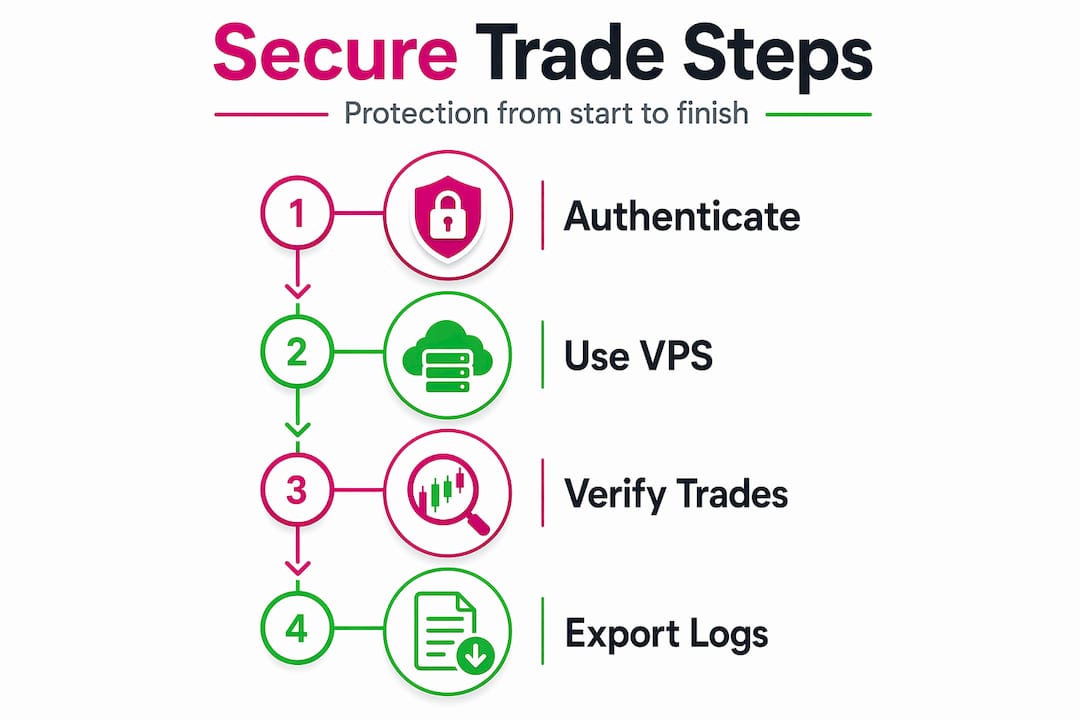
Infographic of secure trade sharing four step flow
Pro Tip: Export and store your trade confirmation logs locally at least once per week. If a dispute ever arises, having your own timestamped records independent of the broker’s system gives you a strong evidentiary position.
Here is a comparison of verification approaches to help you choose what fits your workflow:
| Method | Speed | Tamper-proof | Best for |
|---|---|---|---|
| Platform-native confirmation | Immediate | Yes (within platform) | All traders |
| Email trade receipts | Minutes | Moderate | Retail traders |
| Blockchain audit trail | Near real-time | Very high | Account managers, high volume |
| Manual log export | Manual | Depends on storage | Educators, compliance |
| Account alert monitoring | Real-time | Yes | Everyone |
My honest take on trade sharing security
Across thousands of Forex traders using Local Trade Copier since 2010, the pattern that surfaces most often is not that traders ignore security. It is that they underestimate how much information they leak through small, casual behaviors.
Someone shares a screenshot in a group chat that has their account number visible in the corner. Someone else sends their signal provider their MT4 password “just to check something.” A third trader uses the same password across their broker, their VPS, and their email. None of these feel like major mistakes in the moment. Together, they create a profile that a motivated bad actor can exploit without any sophisticated hacking at all.
What I have found actually works is treating secure trade sharing as a system, not a checklist. A checklist gets done once and forgotten. A system is how you behave by default. That means your VPS login is always key-based, your trade confirmations are always verified on-platform, and your API keys are always read-only unless you have a specific reason otherwise.
The traders who handle this best are usually the ones managing multiple accounts or running education programs. They have to share trade information regularly, so they built repeatable, secure habits early. If you are only managing your own account, it is easy to feel like this does not apply to you. But the moment you bring in a second account or share access with even one other person, your exposure multiplies. A forex trading security checklist is worth building now, before you need it.
— Rimantas
How Mt4copier supports secure trade replication
If you are looking for a way to copy trades across multiple MT4, MT5, or DXTrade accounts without routing data through a cloud server, Mt4copier’s Local Trade Copier runs entirely on your local Windows machine or VPS.
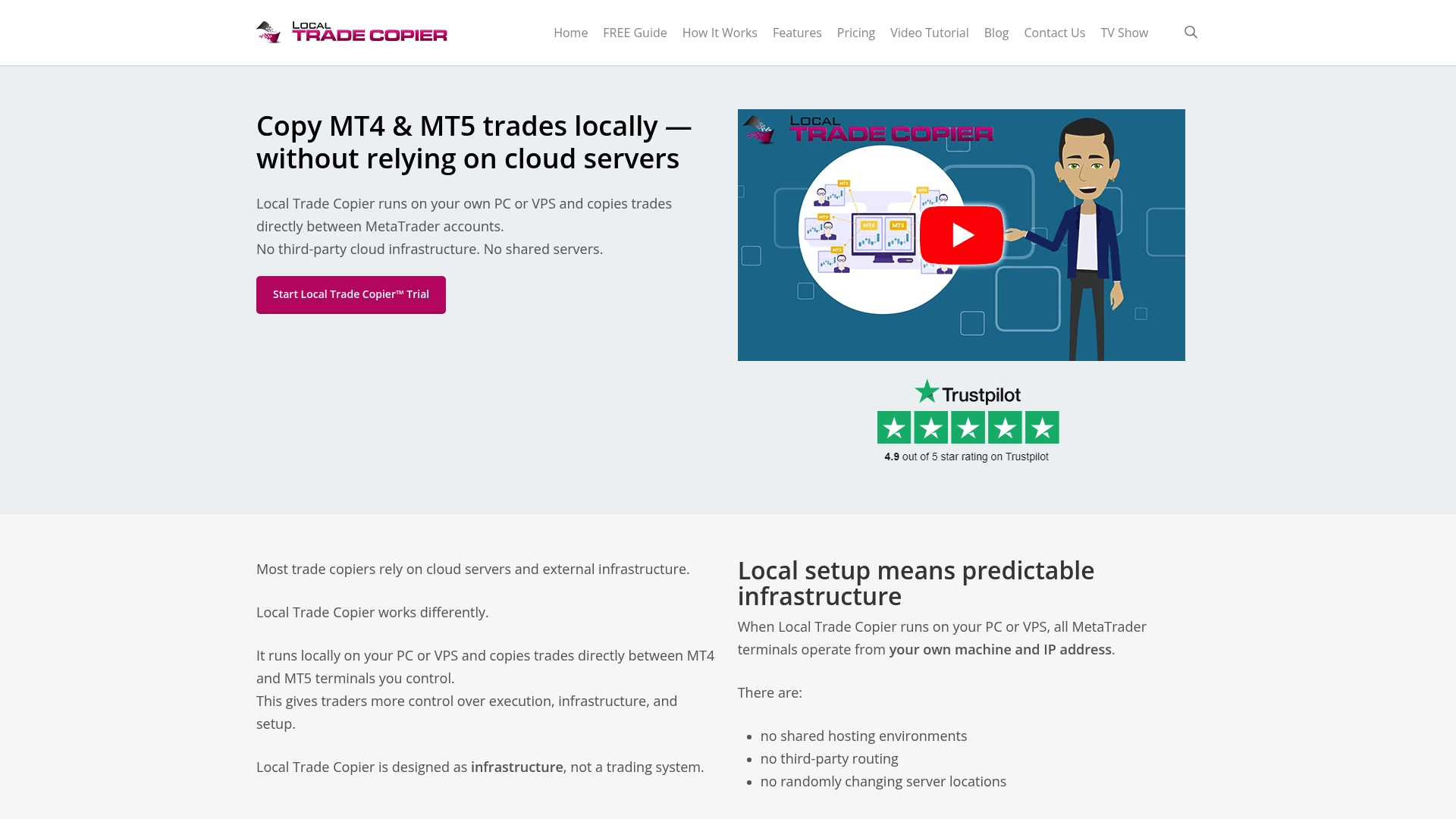
All trade data stays on one machine, one IP address, with no external server handling your positions. That architecture removes the cloud routing risk that concerns prop firm traders and account managers most. You can protect that environment further by following VPS and password security practices that Mt4copier covers in detail. If you want to see how the software works before committing, a demo walkthrough is available, and a 7-day free trial gives you full access to test it against your own accounts. Mt4copier has served over 3,000 traders since 2010.
FAQ
What is the safest way to share trade information?
Use a zero-knowledge, self-destructing note service and split the link and password across two separate channels. Always keep trade conversations inside the regulated platform rather than moving them to external messaging apps.
How do I exchange trades safely with a new counterparty?
Run a small test transaction first to confirm their identity and platform behavior before sharing any significant trade data. Verify their account status directly on the platform, never through screenshots or external messages.
Why should I avoid sharing trades via WhatsApp or Telegram?
Standard messaging apps retain message histories, are vulnerable to SIM-swap attacks, and provide no escrow or dispute resolution. Sensitive data in messaging apps is far more exposed than data shared through platform-native tools.
What authentication method is best for protecting trade accounts?
App-based TOTP authentication or FIDO2 hardware keys are the strongest options. SMS-based 2FA is better than nothing but can be bypassed through SIM-swapping, making it the weakest of the three.
How often should I audit my trade confirmations?
Review your trade confirmations and account statements at minimum once per week. Set up real-time alerts through your broker for logins, trades, and withdrawals so you catch anything unusual the moment it happens rather than after the fact.
Recommended
- Secure Forex Trade Workflow: Your 2026 Practical Guide
- Sharing Your Winning Forex Trades With Friends and Family
- Forex Trading Security Checklist: Protect Accounts & Copy Safely
