
TL;DR:
- Most beginner forex traders fail because they lack rules, focusing on discipline and risk management instead.
- Defining trades beforehand, controlling risk with stop-losses, and maintaining focus are essential for consistent success.
Most new forex traders blow their first account not because they picked the wrong strategy, but because they had no rules at all. The essential forex trading rules covered in this article are not abstract theory. They are the specific habits and controls that separate traders who survive their first year from those who don’t. You will learn how to define your trades before you take them, manage risk with precision, focus your attention where it counts, and build the behavioral discipline that makes consistent trading possible. Master these, and you have a real foundation to work from.
Key Takeaways
| Point | Details |
|---|---|
| Plan every trade before entry | Define your entry reason, stop-loss, and take-profit levels before you click the buy or sell button. |
| Risk only 1%–3% per trade | Limiting your exposure per trade lets you survive losing streaks and stay in the market long enough to learn. |
| Narrow your focus deliberately | Trade fewer pairs, fewer strategies, and one consistent session to reduce errors and build real skill. |
| Use an economic calendar daily | Avoid entering trades within 15 minutes of high-impact news releases to limit sudden volatility exposure. |
| Journal every trade you take | Recording your decisions and outcomes is the fastest way to identify patterns and reduce emotional trading. |
1. Define your trade before you enter it
The single most reliable marker of a disciplined trader is whether they can answer three questions before entering any position: why am I entering this trade, where does my stop-loss go, and where is my take-profit target?
If you can’t answer all three before clicking the button, you are not trading. You are guessing. FXCC identifies this pre-trade checklist as one of the most frequently violated forex trading guidelines among beginners, and for good reason. Without a defined reason, stop, and target, you have no way to evaluate the trade after the fact.
This matters beyond the single trade. Every time you skip this step, you train yourself to act on impulse. Over dozens of trades, that habit becomes the reason your account drifts downward even during periods when your strategy should be working.
- Entry reason: A specific signal from your method, not a feeling or a guess.
- Stop-loss level: A price that, if hit, tells you the trade thesis is wrong.
- Take-profit level: The price where you want to exit if you are right.
Pro Tip: Write your entry reason, stop, and target on paper or in a notes app before you execute. The physical act of writing slows you down enough to catch bad trades before they happen.
2. Always use stop-loss orders. Every single time.
A stop-loss is not optional. It is the mechanism that keeps a single losing trade from becoming an account-destroying event. Setting stop-loss orders consistently is emphasized across every credible set of best practices for forex trading, and yet beginners routinely skip them when they are “confident” in a trade.
That confidence is exactly when the stop matters most. The market does not care about your conviction. Price can move against you at any speed, for any reason, at any time.
Set the stop-loss before the trade executes, not after. Setting it afterward creates a window where a fast move can catch you without protection. More practically, placing the stop first forces you to think about risk before you think about reward. That sequence matters psychologically.
3. Calculate your position size based on risk, not preference
Position sizing is where most traders quietly destroy their accounts. They choose lot sizes based on what “feels right” or what they used last time, rather than calculating what the trade’s stop-loss distance actually calls for.
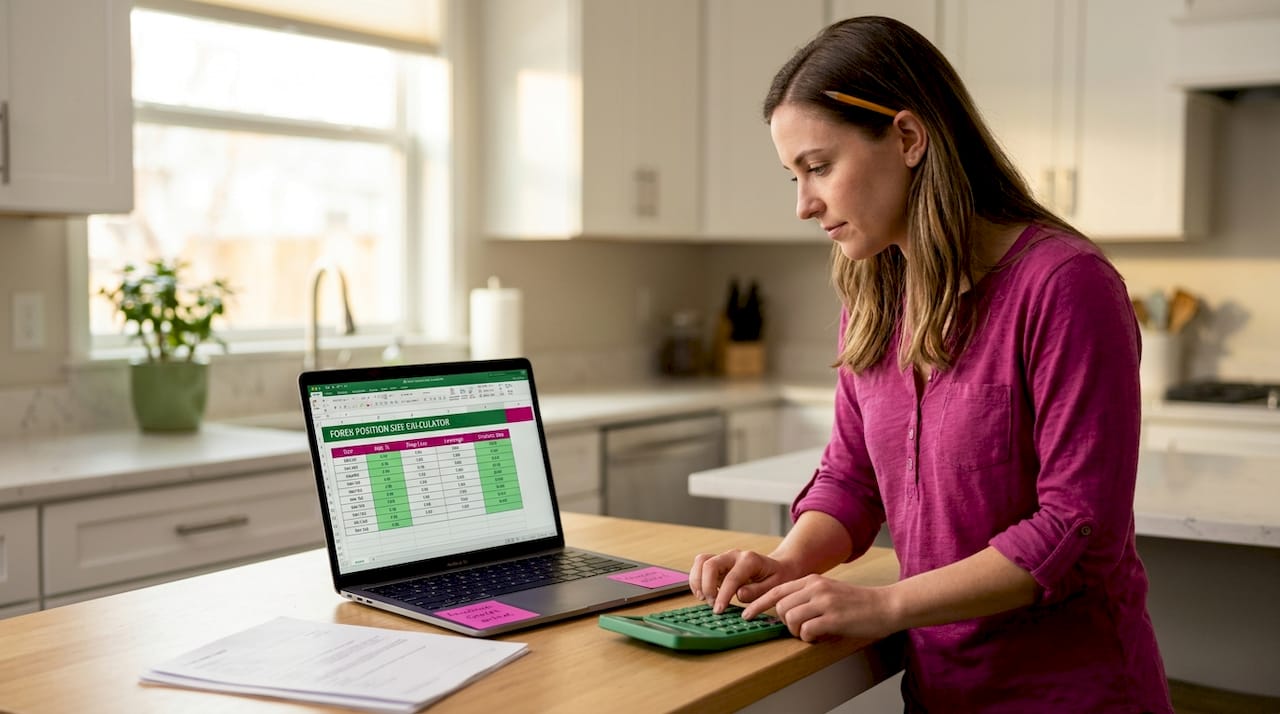
Woman calculating forex position size at desk
The correct approach: decide what dollar amount or percentage of your account you are willing to lose on this trade, then let the stop-loss distance determine your position size. Risk no more than 1%–3% of account equity per trade. That range is not arbitrary. It is the threshold that lets you absorb a losing streak of ten, fifteen, or twenty trades without being forced out of the market. Past results do not guarantee future performance, but the math on survival is clear: smaller risk per trade means more chances to recover.
Stop-loss placement directly determines position size through the risk calculation. A wider stop requires a smaller lot size to maintain the same dollar risk. This is why stop placement is a risk decision, not just a technical one.
| Scenario | Account Balance | Risk Per Trade (1%) | Stop-Loss Distance | Position Size (Approx.) |
|---|---|---|---|---|
| Conservative | $5,000 | $50 | 20 pips | 0.25 lots |
| Conservative | $5,000 | $50 | 50 pips | 0.10 lots |
| Moderate | $10,000 | $100 | 20 pips | 0.50 lots |
| Moderate | $10,000 | $100 | 50 pips | 0.20 lots |
Pro Tip: Cap your total open exposure at 3%–5% across all trades simultaneously. Correlated risk across open positions can concentrate your losses fast when multiple pairs move together.
4. Use low leverage while you are still learning
Leverage amplifies both gains and losses. A 1:100 leverage account means a 1% move against you wipes out your entire margin. Using low leverage, at 1:10 or less, is one of the smartest forex risk management tips for beginners because it keeps losses proportional to mistakes while your skills are still developing.
High leverage feels attractive because it makes small accounts feel larger. That is the trap. The same force that multiplies a winning trade will multiply a losing one. Until you have a tested, consistent method and at least a few months of real trading experience, keep leverage low and treat the market with appropriate respect.
5. Narrow your focus with the 5-3-1 framework
One of the most common forex trading mistakes beginners make is spreading attention across too many currency pairs, strategies, and trading hours. The result is shallow knowledge everywhere and real skill nowhere.
The 5-3-1 framework solves this directly. It means focusing on no more than 5 currency pairs, learning 3 trading strategies deeply, and trading during 1 consistent daily session. This structure forces repetition, which is how pattern recognition actually develops.
- Five pairs: Pick major pairs like EUR/USD, GBP/USD, and USD/JPY. These have the tightest spreads and the most available analysis.
- Three strategies: Choose approaches that suit your schedule and personality, then learn them thoroughly before adding new ones.
- One session: The London session, the New York session, or the overlap between them are the most liquid windows. Pick one and own it.
Restricting trading to fewer pairs and consistent sessions measurably reduces emotional decision-making and overtrading. When you know your pairs deeply, you recognize when something is off and stay out. That restraint is a skill in itself.
6. Spend real time on demo accounts before going live
Demo trading gets dismissed as fake practice by traders who are impatient to make money. That impatience is expensive. Practicing on demo accounts for 60 to 90 days before trading live gives you a window to test your strategy, build your pre-trade checklist habit, and discover the flaws in your approach before real money is at stake.
What demo trading cannot replicate is the emotional pressure of live positions. That is real and worth acknowledging. But it can teach you execution mechanics, help you spot strategy weaknesses, and give you a baseline performance benchmark to compare against when you go live. Learn when to move from demo to live trading based on consistent results, not impatience.
7. Check your economic calendar before every session
High-impact economic events, including central bank decisions, non-farm payrolls, and CPI releases, can move currency pairs by dozens of pips in seconds. New traders who ignore these events get caught in violent, unpredictable moves that have nothing to do with their technical setup.
Avoiding new trades within 15 minutes of high-impact releases is a practical rule that reduces volatility exposure significantly. Make checking an economic calendar a non-negotiable part of your pre-session routine.
- Review high-impact events for the day before your session opens.
- Mark the time windows around major releases and avoid new entries during them.
- If you have open trades near a release, know your plan: either tighten your stop or accept the risk with eyes open.
Pro Tip: You can also study how economic indicators move markets to better understand why certain releases cause bigger reactions, which helps you prioritize which events to watch most carefully.
8. Build discipline through journaling and emotional controls
Risk management is the primary determinant of long-term survival in forex, more than strategy selection. And the tool that reinforces risk management day after day is a trading journal.
Keeping a detailed trading journal means recording your entry and exit reasons, the emotional state you were in, and what you would do differently. Over time, patterns emerge. You might notice you trade well in the morning and terribly after a losing streak. You might find that certain setups you think work actually don’t when you review the data honestly.
Alongside journaling, set behavioral rules:
- Daily loss limit: If you lose a set dollar amount in one day, stop trading. Full stop.
- No revenge trades: Taking a trade to “win back” a loss is one of the fastest ways to turn a small loss into a catastrophic one.
- Treat trading as a skill: You are not trying to predict the market. You are building a repeatable process that gives you a positive expectancy over many trades. Past results do not guarantee future performance.
A strict drawdown framework that pauses or reduces your trading size after certain losses prevents the emotional blowups that wipe accounts in a single session.
My honest take on what actually separates survivors from quitters
I’ve watched traders approach forex with brilliant strategy ideas and terrible habits, and I’ve seen traders with unremarkable methods build accounts steadily because they follow simple rules without exception.
Here’s what I’ve learned: most beginners spend 90% of their energy searching for the perfect strategy and 10% on execution discipline. That ratio should be flipped. The best rules emphasize execution control over market prediction. The market is too complex to predict consistently. What you can control is your position size, your stop placement, and whether you follow your own rules when it’s uncomfortable.
The traders who last are not the ones with the most creative ideas. They are the ones who have internalized that surviving a bad streak is more valuable than catching a big move. Build the habits first. The strategy will have room to breathe once the rules are protecting you.
— Rimantas
How Mt4copier supports disciplined trade execution
Knowing the rules is one thing. Executing them consistently across multiple accounts without errors is a different challenge entirely.
Mt4copier’s Local Trade Copier is built for traders who want their execution to match their plan, every time. When you set stop-loss and take-profit levels on your master account, Mt4copier replicates stops and targets to every connected account in 1 second or faster under normal market conditions, with no manual re-entry and no missed levels. The software also includes eight money management modes, so position sizes scale correctly across accounts with different balances. For traders managing multiple personal accounts or running a strategy across funded accounts, this removes the execution errors that undermine consistent execution even when your discipline holds. You can explore installation on MT4 and MT5 and start with a 7-day free trial to see how consistent replication feels in practice.
FAQ
What are the most important forex trading rules for beginners?
The most critical rules are defining your entry reason, stop-loss, and take-profit before every trade, risking no more than 1%–3% of your account per trade, and never skipping a stop-loss order. These three controls form the foundation of sustainable trading practice.
How much should a beginner risk per forex trade?
Most credible forex trading guidelines recommend risking no more than 1%–3% of your account equity on any single trade. This range lets you absorb a long losing streak without being forced out of the market.
How long should I practice on a demo account?
A minimum of 60 to 90 days on a demo account gives you enough time to test your strategy, develop consistent habits, and identify weaknesses before real money is at stake. Moving to live trading based on consistent demo results, not impatience, is one of the best practices for forex trading beginners can follow.
Why should I avoid trading around economic news releases?
High-impact economic events can move currency pairs sharply and unpredictably within seconds of release. Avoiding new trades within 15 minutes of these events, as forex trading guidelines consistently recommend, reduces your exposure to volatility that has nothing to do with your technical setup.
Does a trading journal actually help performance?
Yes. Recording your trades, the reasoning behind them, and your emotional state at the time creates a data set you can review objectively. Over time, journaling reveals patterns in both your winning and losing trades that are invisible in the moment.
Recommended
- Teaching Forex Trading Efficiently: A Beginner’s Roadmap
- Forex Trading For Beginners: 3 Profitable Strategies For 2023
- Top 13 Mistakes That Forex Traders Should Avoid | Trade Copier for MT4 & MT5
